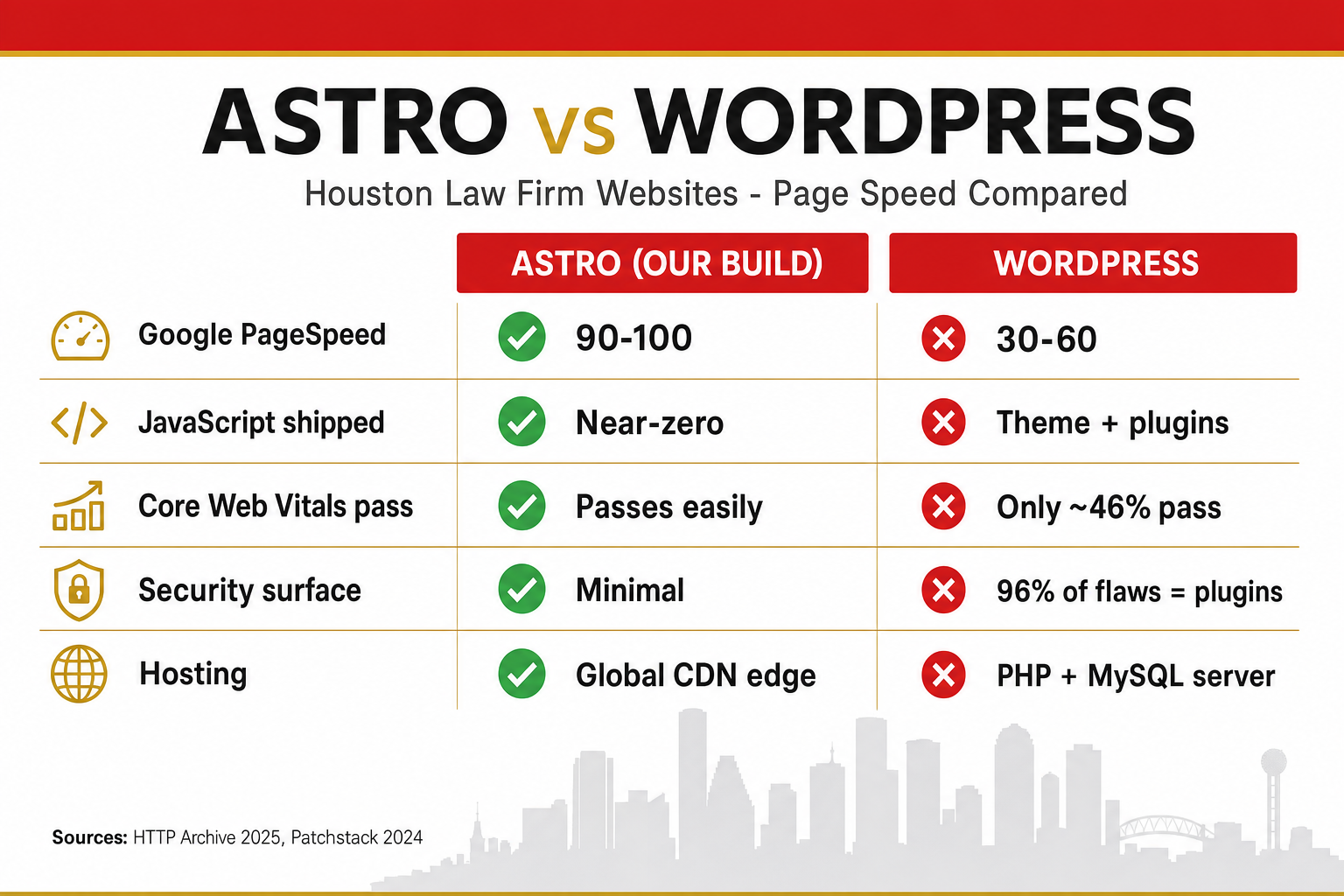
Astro or WordPress for a Houston law firm website — which is faster?
For a Houston law firm, Astro is the faster choice by a wide margin. Astro is a static-first framework that ships almost no JavaScript to the browser, so its pages paint in well under a second and routinely score 90–100 on Google PageSpeed. A typical WordPress site — built on a theme plus a stack of plugins — ships far more code, and a large share of WordPress sites fail Google’s Core Web Vitals as a result. When your website is your intake front door, that speed gap is the difference between a signed accident case and a prospect who bounced to the firm ranked below you.
That matters more in Houston than almost anywhere. Texas has 116,127 active attorneys as of year-end 2024, and Harris County — Houston — holds the single largest concentration of them in the state (State Bar of Texas, 2024). Personal injury, immigration, family, and criminal defense firms are all bidding for the same clicks. When a car-accident victim searches “Houston injury lawyer” on their phone at 11 p.m., the firm whose page loads instantly gets read; the firm whose page hangs for four seconds gets closed. Google’s own research is blunt about this: as a mobile page’s load time grows from 1 second to 3 seconds, the probability that the visitor bounces jumps 32% (Think with Google / SOASTA, 2017).
This guide compares Astro and WordPress head-to-head on the things that actually decide whether a Houston firm’s website earns cases: page speed, Core Web Vitals, SEO, editability, security, and total cost. It’s written for two readers — the firm owner picking a platform and the agency deciding what to build for legal clients.
Key Takeaways
- Speed is a conversion lever, not a vanity metric. A one-second B2B/lead-gen site converts roughly 3× better than a five-second site (Portent, 2022). For a Houston firm paying $100+ per click, that gap is real money.
- Astro ships near-zero JavaScript by default. Its islands architecture sends fully-formed HTML from the edge, so pages paint instantly (Astro Docs). WordPress ships a theme plus every plugin’s scripts on every page.
- WordPress powers ~43% of the web and ~59% of the CMS market (W3Techs, 2026) — which is exactly why it’s the default your firm is weighing. Popular ≠ fast.
- Core Web Vitals are a Google ranking signal. LCP under 2.5s, INP under 200ms, CLS under 0.1 (web.dev). A slow WordPress build can quietly cap how high you rank in Houston searches.
- The fix is boring and effective: build the marketing site static-first (Astro), guarantee a 90+ score, and wire it to a fast intake system so the speed actually converts into booked consultations.
Table of contents
- Why website speed decides case volume for Houston firms
- Astro vs. WordPress: the head-to-head comparison
- Core Web Vitals: the scoreboard Google actually uses
- Why WordPress law firm sites get slow
- What Astro gives up (the honest tradeoffs)
- Speed is worthless without intake behind it
- What it costs a Houston firm
- Frequently asked questions
Why website speed decides case volume for Houston firms
Your website isn’t a brochure — it’s the top of your intake funnel. Most legal traffic is mobile, impatient, and comparison-shopping in real time, which means a fraction of a second decides whether a prospect reads your practice areas or taps “back” and calls the next firm. The data on this is unusually consistent across a decade of research.
Google’s mobile speed study, built on machine-learning models from SOASTA, found that the probability of a bounce climbs steeply as pages slow down: +32% from a 1-second to a 3-second load, +90% at 5 seconds, and +106% at 6 seconds (Think with Google, 2017). Every second your Houston firm’s homepage spends loading is a measurable slice of prospects walking out the door.
Increase in mobile bounce probability as page load time grows, relative to a 1-second load. Source: Think with Google / SOASTA (2017).
Speed doesn’t just prevent bounces — it lifts conversions on the visitors who stay. Deloitte and Google’s Milliseconds Make Millions study isolated speed as a variable and found that a mere 0.1-second improvement in mobile load time increased retail conversions by 8.4% and travel conversions by 10.1%, and improved lead-generation page bounce rates by 8.3% (web.dev / Deloitte, 2020). For a firm buying legal clicks — the most expensive keywords in Google Ads — squeezing more conversions from the same traffic is the cheapest growth you can buy.
Business lift from a 0.1-second mobile speed improvement. Source: web.dev / Deloitte, “Milliseconds Make Millions” (2020).
And Portent’s analysis of over 100 million pageviews put a hard multiple on it: a B2B/lead-generation site that loads in 1 second converts about 3× better than one that loads in 5 seconds, and 5× better than a 10-second site (Portent, 2022). If you’ve ever wondered why your paid campaigns underperform, your site speed is a prime suspect — this connects directly to speed-to-lead, where the same impatience that closes a slow page also punishes a slow callback.
Astro vs. WordPress: the head-to-head comparison
Both platforms can produce a good-looking law firm website. The difference is what the browser has to download to render it — and that difference cascades into speed, SEO, security, and maintenance. Here’s the honest side-by-side for a legal marketing site.
| Factor | Astro (static-first) | WordPress (theme + plugins) |
|---|---|---|
| Google PageSpeed (mobile) | 90–100, guaranteed on our builds | Frequently 30–60 without heavy optimization |
| JavaScript shipped | Near-zero by default; only interactive “islands” hydrate | Theme + every active plugin’s JS on most pages |
| Hosting | Static files on a global CDN edge (Cloudflare) | PHP + MySQL server; needs caching plugins to keep up |
| Core Web Vitals | Passes easily (fast LCP, low CLS) | A large share of WP sites fail without tuning |
| Security surface | Minimal — no database or plugin exec on page load | Plugins are the #1 source of WordPress vulnerabilities |
| Maintenance | Managed; no plugin update treadmill | Ongoing plugin/theme/core updates & conflicts |
| Editing content | Via a managed process or headless CMS | Familiar wp-admin dashboard (its real advantage) |
| Custom code & schema | First-class; clean SEO/AEO/GEO markup | Possible, but often fought against by the theme |
The short version: WordPress optimizes for do-it-yourself editing; Astro optimizes for what the visitor experiences. For a marketing site whose entire job is to load fast, rank, and convert, the visitor’s experience is the one that pays your bills. That’s the exact tradeoff behind our Get a Website build — Astro under the hood, a 90+ PageSpeed guarantee on top.
Core Web Vitals: the scoreboard Google actually uses
Core Web Vitals are the three metrics Google uses to grade real-world page experience, and page experience is a confirmed ranking signal. If your Houston firm’s WordPress site fails them, you’re not just annoying visitors — you’re handing an SEO edge to every competitor whose site passes.
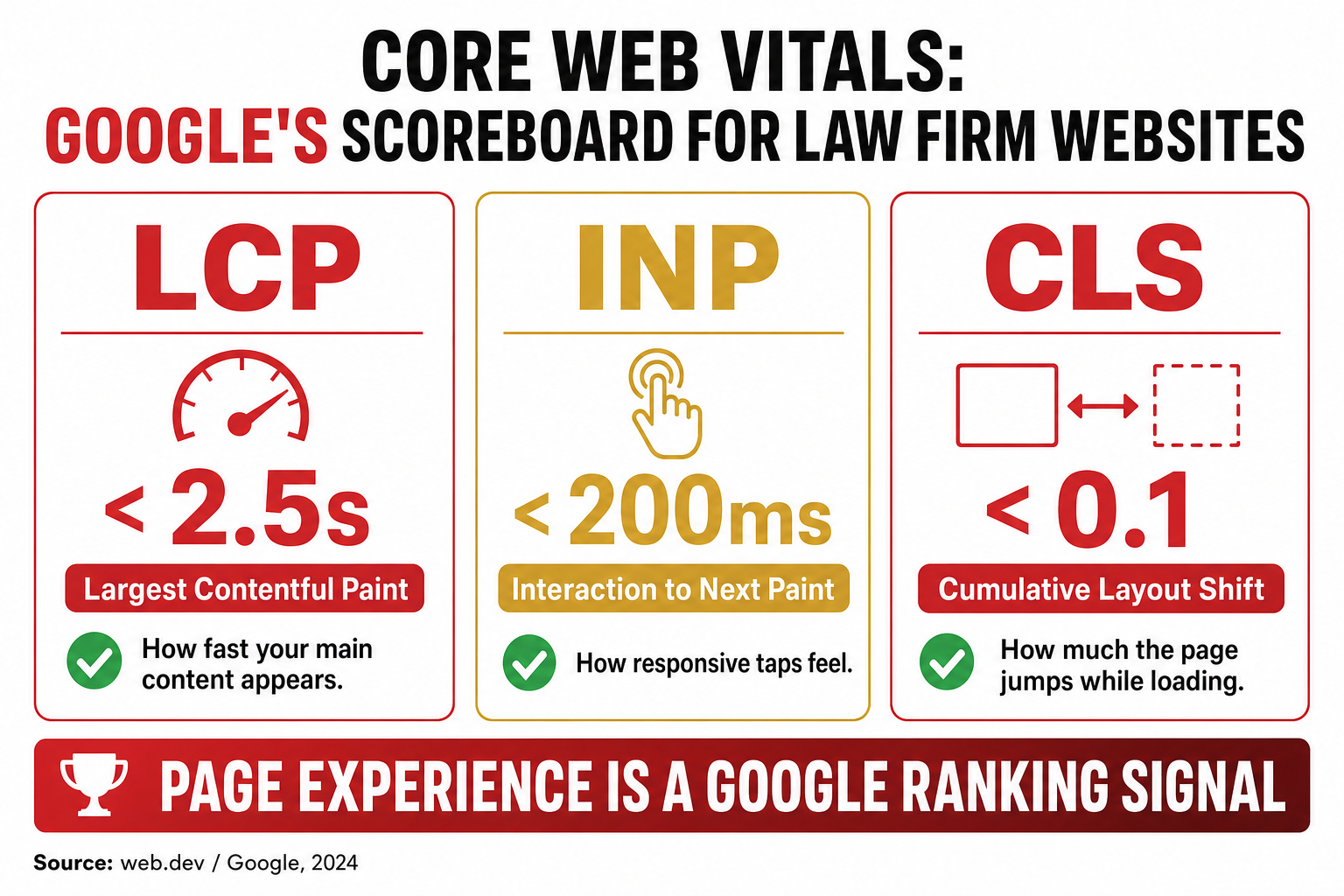
The three thresholds you have to clear (web.dev):
- Largest Contentful Paint (LCP) — under 2.5 seconds. How fast your main content (your hero headline, your “Free Consultation” button) actually appears. Astro’s server-rendered HTML paints this almost immediately; a JavaScript-heavy WordPress theme often can’t.
- Interaction to Next Paint (INP) — under 200 milliseconds. How responsive the page feels when a prospect taps a menu or a form field. INP replaced First Input Delay as a Core Web Vital in March 2024, and it punishes exactly the heavy JavaScript that plugin-laden WordPress sites tend to ship.
- Cumulative Layout Shift (CLS) — under 0.1. Whether the page jumps around while loading — the maddening effect where you go to tap “Call Now” and an ad slides it out from under your thumb.
This isn’t theoretical. HTTP Archive’s Core Web Vitals data shows that only about 46% of WordPress origins pass all three Core Web Vitals, versus roughly 85% for the fastest managed and static-first platforms (HTTP Archive, via Search Engine Journal, 2025). More than half of WordPress sites are failing the exact test Google uses to grade page experience.
Share of origins passing all three Core Web Vitals, by platform. Source: HTTP Archive Core Web Vitals Technology Report, via Search Engine Journal (2025).
Because Astro sends finished HTML from the edge with almost no client-side JavaScript to parse (Astro Docs), passing all three is close to automatic. On WordPress it’s a project — caching plugins, a CDN, image optimization, lazy-loading, and script deferral all bolted on to claw back the performance the platform gave away by default.
Why WordPress law firm sites get slow
WordPress isn’t “bad.” It powers roughly 43% of all websites and about 59% of the CMS market for good reasons — it’s flexible, familiar, and has a plugin for everything (W3Techs, 2026). But the very thing that makes it easy is what makes the typical law firm build slow.
Here’s the usual path to a sluggish legal site:
- The theme. A visually rich law firm theme ships its own CSS and JavaScript framework, sliders, and animation libraries — most of which load on every page whether they’re used or not.
- The plugins. A contact form plugin, an SEO plugin, a page builder (Elementor/Divi), a chat widget, a booking tool, an analytics stack. Each injects more scripts and database queries. Page builders in particular are notorious for bloated, deeply-nested markup.
- The server. WordPress assembles each page from PHP and a MySQL database on request, so without aggressive caching your time-to-first-byte suffers before a single pixel renders.
- The security tax. More plugins means a bigger attack surface. Patchstack found that 96% of WordPress vulnerabilities disclosed in 2024 came from plugins — 7,633 of them — with themes a distant second (Patchstack, State of WordPress Security in 2024). For a law firm handling sensitive client intake data, that’s not just a performance problem — it’s a professional-responsibility one, and an unpatched plugin can take a site down entirely.
None of these are individually fatal, but they stack. A firm adds one more “helpful” plugin every few months, and two years later the homepage takes five seconds to load on a phone — right in the zone where Google’s data says a third or more of visitors bounce. Astro sidesteps the whole cycle by not shipping the code in the first place. If your firm also needs deeper automation — custom portals, integrations, AI intake — that’s a job for purpose-built GHL development or custom software, not another WordPress plugin stacked on a slowing site.
What Astro gives up (the honest tradeoffs)
No platform is free. Being straight about Astro’s tradeoffs is the only way to make a real decision.
- Editing isn’t the classic wp-admin dashboard. WordPress’s genuine strength is that a non-technical staffer can log in and edit a page. A static Astro site is typically updated through a managed service or a headless CMS. For most firms this is a feature, not a bug — you get changes done by someone who won’t break the layout — but if daily self-editing by multiple staff is non-negotiable, weigh it honestly. (Our build includes managed support tickets so changes still happen fast.)
- It’s a build, not a template you self-install. You don’t spin up an Astro law firm site from a one-click host the way you might with a WordPress theme. It’s built for you. That’s why it’s fast and clean — and why it’s a done-for-you service.
- Massive, complex web apps have other considerations. For a marketing + intake site (which is what a law firm needs), Astro is ideal. For, say, a client-facing SaaS portal, that’s a different tool — again, custom software territory.
For the specific job of a Houston law firm marketing site — load fast, rank in local search, convert visitors into consultations — the tradeoffs land firmly in Astro’s favor.
Speed is worthless without intake behind it
Here’s the part most “fast website” pitches skip. A 100/100 PageSpeed score gets the prospect to read your page and tap the button. What happens in the next five minutes decides whether that becomes a signed case — and a fast website wired to slow intake is a Ferrari with no driver.
The same impatience that closes a slow page also punishes a slow response — and most firms are losing here. In Clio’s secret-shopper research, only 40% of law firms answered the phone and just 33% responded to an email inquiry (Clio 2024 Legal Trends Report). A prospect who fills out your form at 9 p.m. expects a reply now, not tomorrow morning. That’s why our law firm websites don’t ship as static brochures — they come wired into an intake system: an AI chatbot that answers instantly, missed-call text-back so no inquiry goes dark, and automated booking so a hot lead can put a consultation on the calendar before they message the next firm. Combine a fast site with fast follow-up and your cost per signed client drops on both ends. For the full picture of turning traffic into clients, see how to get more clients for your law firm and law firm local SEO.
What it costs a Houston firm
The real comparison isn’t “Astro vs. WordPress” as software — both can be cheap or expensive. It’s the total cost: build, hosting, plugins, security, and the ongoing performance tuning WordPress needs to stay fast. A DIY WordPress site looks cheap until you add a premium theme, paid plugins (forms, SEO, caching, booking, security), and either your time or a developer’s every time something breaks after an update.
Our done-for-you Astro build is deliberately simple: $497 one-time + $97/month, and you pay only the monthly invoice up front — the one-time fee isn’t charged until the site is live and you’re happy. The $97/month covers managed Cloudflare hosting, your domain, SSL, and maintenance, plus up to 10 support tickets a month for changes. Firms that want content on autopilot can add auto-blogging (2 posts/week) for $197/month total, and multi-office firms can cover up to five sites for $1,200 + $297/month. Full details live on the Get a Website page and pricing.
The point isn’t that WordPress can never be fast — with enough tuning it can. It’s that on Astro, fast is the default, security is simpler, and you’re not on the plugin-update treadmill. For a firm whose website exists to win Houston cases, starting fast and staying fast is worth more than the familiarity of a dashboard.
Frequently asked questions
Is Astro really faster than WordPress for a law firm website?
Yes, meaningfully. Astro is static-first and ships almost no JavaScript by default, so pages paint in well under a second and score 90–100 on Google PageSpeed. A typical WordPress site loads a theme plus multiple plugins on every page, and a large share of WordPress sites fail Google's Core Web Vitals without heavy optimization. For a marketing site whose job is to load fast and convert, Astro wins the comparison that matters.
Why does website speed matter for a Houston law firm specifically?
Houston is one of the most competitive legal markets in the U.S., with high cost-per-click and crowded search results. Google's research shows mobile bounce probability rises 32% as load time goes from 1 to 3 seconds. A slow site taxes you twice — it can rank lower organically and bounces the paid visitors you already paid for — so speed protects both your SEO and your ad budget.
Can't I just install a caching plugin on WordPress?
Caching helps, but it treats the symptom. It doesn't remove the JavaScript the theme and plugins ship, and it adds one more plugin to maintain. Astro avoids the problem by not sending that code in the first place. You can get a WordPress site fast with enough work; on Astro, fast is the default.
What are Core Web Vitals and do they affect my rankings?
Core Web Vitals are Google's three page-experience metrics: Largest Contentful Paint (under 2.5s), Interaction to Next Paint (under 200ms), and Cumulative Layout Shift (under 0.1). Page experience is a confirmed Google ranking signal, so failing them can quietly cap how high your firm ranks in local search. Astro passes all three close to automatically.
What does a done-for-you Astro law firm website cost?
A single site is $497 one-time plus $97/month, and you pay only the monthly invoice up front — the one-time fee is charged after the site is live and you approve it. The monthly covers managed hosting, domain, SSL, maintenance, and up to 10 support tickets. Auto-blogging (2 posts/week) is $197/month total, and up to five sites for multi-office firms is $1,200 + $297/month. See the Get a Website page for details.
Will I still be able to update my own content?
Yes — changes are handled through a managed process (your monthly plan includes support tickets), so updates get made quickly by someone who won't break the layout. If daily self-editing by multiple staff is essential to your workflow, tell us up front and we'll set the site up accordingly. For most firms, managed updates are a feature, not a limitation.
Spencer Ruiz is a GHL Snapshot Implementation Engineer at Lawyer Snapshot who builds and deploys the intake, scheduling, and website systems law firms run on. He writes install-tested playbooks for operators who have to make the technology work on Monday morning. Lawyer Snapshot is a GoHighLevel automation product for U.S. law firms — not a law firm, and not a provider of legal advice.