You are three years into a Clio subscription, a paralegal just quit, and you are staring at a MyCase demo tab wondering if the grass is actually greener or just cheaper. Or you are happy on MyCase, but a bar-association discount for Clio just landed in your inbox and now you are second-guessing everything. Either way, you are about to spend a weekend you do not have comparing two products that both look great in a demo and both cost real money every month, per person, forever.
Here is the short version. Clio and MyCase are the two most popular case management tools for small U.S. firms, they do 80% of the same things, and the right pick comes down to four questions: how many seats you are buying, whether you want intake built in, how allergic you are to being upsold, and how much you value Clio’s much larger integration ecosystem. MyCase is usually the lower sticker and the more bundled product. Clio is the bigger platform with more connections and pricier upper tiers. Neither one fixes the thing that is actually costing you clients, and we will get to that.
Key Takeaways
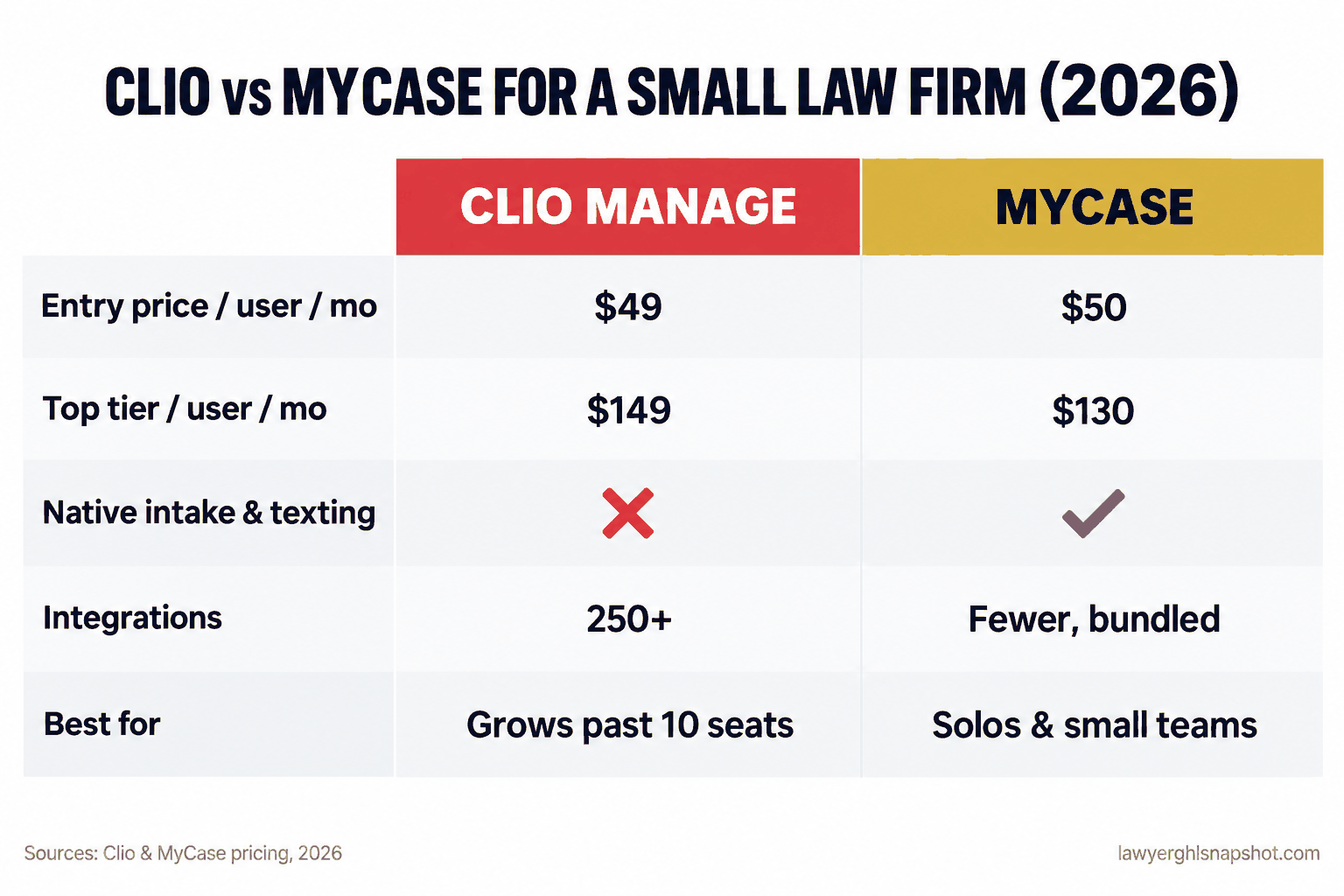
- MyCase is usually cheaper and more bundled. Its 2026 annual tiers are $50 / $100 / $130 per user per month, with native intake, client texting, e-signature and payments in the product (MyCase, 2026).
- Clio is the bigger platform. EasyStart is $49 and the higher tiers run to about $149, most of which Clio now hides behind a “get pricing” form (Clio, 2026). It advertises 250+ integrations (Clio, 2026).
- Both handle IOLTA trust accounting. The difference is which tier or add-on unlocks three-way reconciliation, so confirm that in writing before you sign.
- A migration either direction is a 2 to 6 week project, not a button. The friction is mapping custom fields and matter structures, and nobody fully automates it.
- Neither tool answers your phone or texts a new lead back. That intake gap, not the case-management core, is where small firms quietly lose the most money.
Table of contents
- Clio vs MyCase: the fast verdict
- What do they actually cost in 2026?
- Feature by feature: where they split
- The trust accounting question
- What switching actually costs
- Three firm sizes, three answers
- The gap neither one closes
- Common objections
- FAQ
Clio vs MyCase: the fast verdict (who each one is for)
If you want the decision without the reading, here it is.
Pick MyCase if you are a solo or small team that wants intake, client texting, e-signature and payments in one bill without shopping for add-ons, and the lower per-seat price matters to your budget. MyCase feels more “everything is already here.”
Pick Clio if you expect to grow past 10 people, you rely on a stack of other tools (a specific accounting app, a research platform, a document automation tool) and need them to connect, or you want the market leader with the largest ecosystem. Clio is now part of a much bigger company after its billion-dollar vLex acquisition, which cuts both ways (Clio, 2025).
Pick neither, yet, if your real problem is that leads call after hours and nobody follows up. Case management software organizes clients you already signed. It does not sign new ones. Read the last section first.
What do Clio and MyCase actually cost in 2026?
Both charge per user, per month, with a discount for paying annually. That number decides your bill, because it multiplies by every person you hire.
Clio Manage runs four tiers. EasyStart is $49 per user per month on annual billing, and the higher tiers land around $89, $119, and $149 (Clio, SoftwareAdvice, 2026). The catch: Clio pulled most of those prices off its public site before mid-2026, so its pricing page now shows the $49 entry figure and a “get pricing” prompt for everything above it. When a company hides a number, it rarely moved down.
MyCase runs three tiers: Basic at $50, Pro at $100, and Advanced at $130 per user per month on annual billing, with month-to-month closer to $60 / $120 / $150 (MyCase, 2026). Those numbers went up in 2026 from roughly $39 / $89 / $109, quietly, at renewal (Lawyerist, 2026), so if you signed years ago you may already be paying the new rate. MyCase is now owned by AffiniPay, parent of LawPay, which rebranded to “8am” in 2025 (LawSites, 2025).
The chart below shows the annual per-seat cost of the mid-range plan most small firms actually run on, for an eight-seat firm. This is before implementation, add-ons, and payment-processing fees.
Annual software cost for an 8-seat firm, by plan, before add-ons and implementation. Per-seat prices per Clio and MyCase, 2026.
Read that carefully. At the entry tier the two are within a dollar of each other. The gap opens at the top, and MyCase’s Advanced tier is where many firms end up, because that is where its better features live. “MyCase is cheaper” is true at Basic and gets blurry once you climb.
Feature by feature: where Clio and MyCase actually split
The case-management core is nearly identical. Both give you matter management, a calendar, document storage, time tracking, billing, a client portal, and native payments. If all you need is to organize matters and send invoices, you can run a firm on either. The differences show up at the edges, and the edges are where the money is.
Clio vs MyCase for a small firm, 2026
| Plan | Clio Manage | MyCase |
|---|---|---|
| Price | $49–$149 / user / mo | $50 / $100 / $130 / user / mo |
| Feature 1 | 250+ integrations, the largest ecosystem | Native intake, texting, e-signature, payments |
| Feature 2 | Intake and CRM sold separately as Clio Grow | Fewer integrations, more bundled in the box |
| Feature 3 | Three-way trust reconciliation in the product | Lower entry price, transparent public tiers |
| Feature 4 | Higher upper tiers, most prices quote-gated | Several 'native' features need Pro, not Basic |
| Feature 5 | Best for firms growing past 10 seats | Best for solos and small teams wanting one bill |
Two splits matter most for a small firm.
Intake and marketing. MyCase builds lead and intake management into the product, so a new inquiry can land, get tracked, and get texted from inside the same tool. Clio treats intake and CRM as a separate product, Clio Grow, which is a second purchase (SoftwareAdvice, 2026). One honest caveat: several of MyCase’s “native” features, including intake and client texting, sit on Pro, not Basic, so budget for Pro if those are why you switch (Lawyerist, 2026).
Integrations. This is Clio’s real moat. It advertises 250+ integrations in its app directory (Clio, 2026), covering accounting, research, document automation, and dozens of niche legal tools. After its billion-dollar vLex acquisition and a $5B valuation in late 2025 (LawSites, 2025), expect more AI and research baked in over time. If your firm already runs on a specific stack, Clio is far more likely to connect to it cleanly. MyCase, under the 8am umbrella with LawPay, bundles more into its own product, which is great until you need it to talk to something it does not natively support.
The trust accounting question (do not skip this)
For a lot of small firms this single line decides it, because a trust-accounting mistake is not an accounting problem. It is a bar discipline problem. Commingling client funds or botching a three-way reconciliation is how good lawyers end up in front of a grievance committee.
Both support IOLTA-compliant trust accounting and generate the reports your state bar expects. The difference is the fine print. On MyCase, basic trust management is on all plans, but full three-way reconciliation runs through the MyCase Accounting add-on, roughly an extra $39 a month per accounting user, which lines up with the Advanced tier (Lawyerist, 2026). Clio positions three-way reconciliation as a headline strength inside the practice-management product, so confirm the exact tier for your plan.
If trust accounting is a live worry, our law firm IOLTA trust-accounting compliance guide covers the reconciliation cadence and the reminders that keep you audit-ready regardless of which software you land on.
What does switching between them actually cost?
The demo makes migration sound like a weekend. It is not. Moving a live firm from Clio to MyCase, or back, is a 2 to 6 week project, and the software sticker price is the smallest part of it.
Both platforms let you export your data: contacts, matters, time, and billing to CSV, documents as folders or a ZIP. MyCase even publishes a guide for exporting out of Clio (MyCase, 2026), and Clio publishes migration guides for firms coming the other way (Clio, 2026). Export is not the hard part. Here is where migrations actually break.
Custom fields do not map cleanly. Clio lets firms build custom fields and matter structures that MyCase organizes differently, so some structure flattens or lands wrong on import. Fix: import into a sandbox and hand-check ten real matters before you cut the firm over.
Document links break. Documents move, but the associations between a document and its matter can drop. Fix: verify document-to-matter links on your most active open cases immediately, not a month later.
Trust balances need a manual audit. Never trust an automated trust import. Fix: reconcile every client trust ledger by hand against your bank statement on day one. Never skip this step.
Two systems run at once for a while. For a few weeks you keep both live so nothing in flight gets lost. Fix: set a hard cutover date and make the old system read-only after it.
The honest takeaway: switching is worth it when the new tool solves a real, recurring pain, not to save ten dollars a seat. The migration cost and the productivity dip while your team relearns everything will eat that saving for a year.
Three firm sizes, three different answers
The right pick changes with headcount, because per-seat pricing punishes growth.
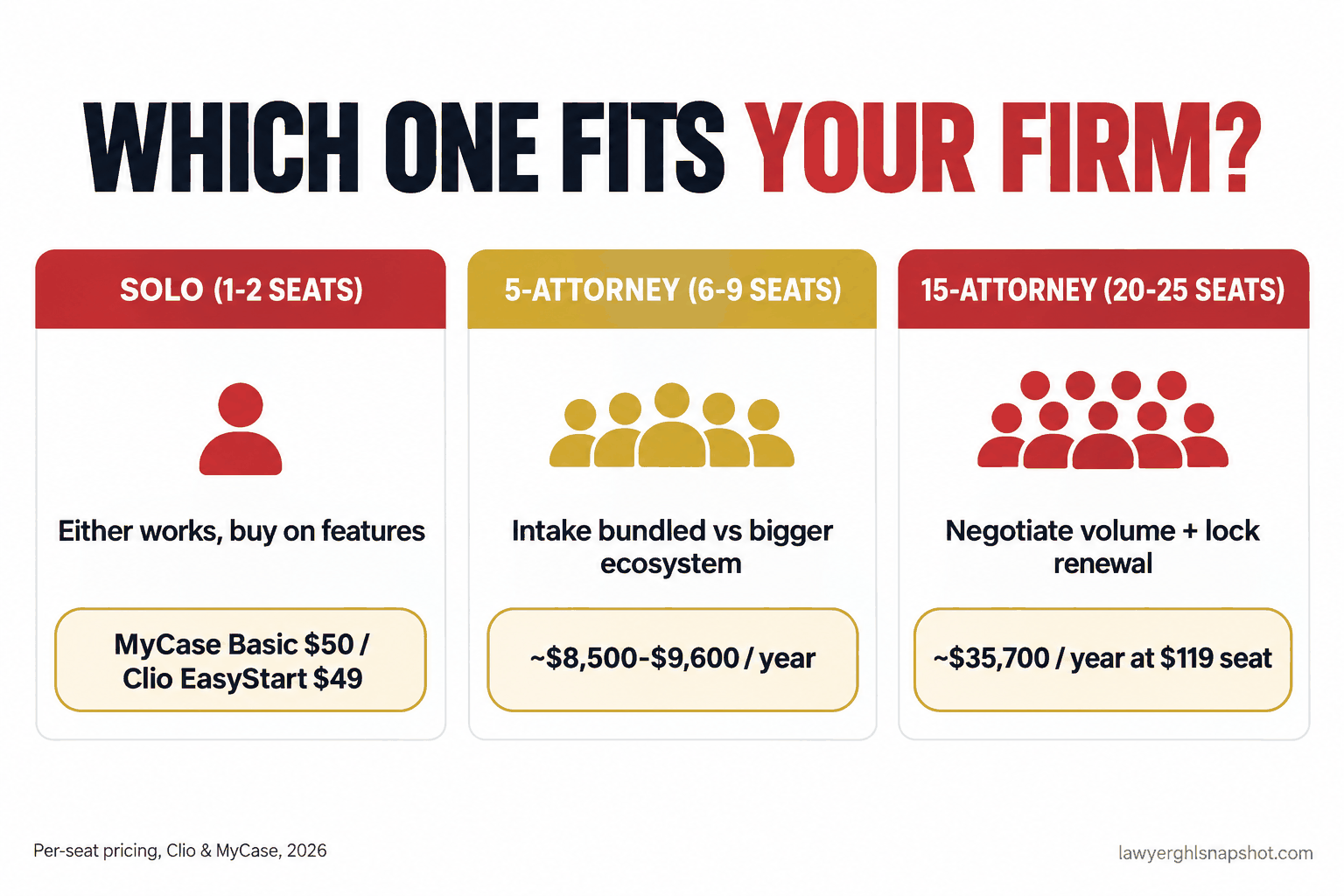
The solo (1 to 2 seats). Your software bill is a rounding error next to one signed case, so do not agonize over ten dollars a seat. MyCase Basic at $50 bundles intake so you are not wiring a second tool on day one. Clio EasyStart at $49 is just as capable on the core, with a bigger ecosystem to grow into.
The 5-attorney firm (6 to 9 seats). Here the tier you choose starts to bite, because you multiply by eight. At MyCase Pro ($100) or Clio Essentials ($89) you spend $8,500 to $9,600 a year on software alone. If you run a specific accounting or research tool, Clio’s integrations earn their keep. If you want intake, texting, and payments in one bill, MyCase Pro is cleaner. Either way, this is the size where an unmanaged intake leak costs more than the whole software bill.
The 15-attorney firm (20 to 25 seats). Now per-seat pricing is a serious line item: 25 seats of a $119 plan is roughly $35,700 a year. Push for volume pricing and lock the renewal rate in writing. Clio’s larger ecosystem usually wins here, but only if you use the integrations you pay for.
Illustrative annual cost of MyCase Pro ($100/user/mo) as a firm grows. The software does not change, only the headcount, and the bill scales with it. Source: MyCase pricing, 2026.
The gap neither Clio nor MyCase closes
Here is the thing both demos skip. Clio and MyCase are systems of record. They organize a client once that client is in your system. Neither answers the phone at 7pm, texts back the person who filled out your contact form, or chases the lead who ghosted after the first call.
That matters because of where firms leak money. The average lawyer captures only about 38% of an eight-hour day as billable time, invoices 88% of that, and collects 93% of what is invoiced, per Clio’s own 2025 Legal Trends Report (Clio, 2025). The biggest leak sits before intake: the lead who called while you were in court and never heard back. The odds of connecting drop sharply after the first few minutes, which is why speed to lead decides more cases than any feature comparison. Neither tool sends this on its own, so here is the copy to steal.
Missed-call text-back (fires within 60 seconds of a missed call):
“Hi, this is [Firm Name]. Sorry we missed your call. This is a real person on our team and we can help. Are you reaching out about a new matter? Reply here and we’ll get you scheduled. (Reply STOP to opt out.)”
New web lead, first text (within 5 minutes of a form fill):
“Hi [First Name], this is [Name] at [Firm Name]. Thanks for reaching out about your [practice area] matter. I can get you a free consult this week. Does tomorrow morning or afternoon work better? (Reply STOP to opt out.)”
No reply next day (final nudge):
“Hi [First Name], I don’t want your matter to fall through the cracks. We keep a couple of consult slots open each day and I’d like to hold one for you. Here’s the link to grab a time: [link]. If now isn’t right, reply LATER and I’ll check back.”
That cascade, running the moment a lead comes in, converts more consultations than any feature you will compare between Clio and MyCase. Texting clients has real compliance rules, so read our law firm texting and AI chatbot compliance guide first and keep the consent language in every message. The full mechanics live in our missed-call text-back playbook. Decide the case tool second and the lead-capture layer first.
Common objections
“We already pay for Clio. Isn’t switching a waste?” Usually, yes. Only switch if MyCase solves a specific, recurring pain. If Clio’s core works and your team knows it, the migration cost and learning dip outweigh a small per-seat saving. Fix the intake leak on top of Clio instead.
“MyCase is cheaper, so that settles it.” It is cheaper at Basic. The features that make firms switch, intake and client texting, live on Pro at $100 a seat, close to Clio Essentials. Compare the tier you will actually run on, not the banner price.
“I want everything in one tool.” Reasonable, and it favors MyCase for the case-and-billing core. But no case-management tool, MyCase included, is a real marketing and intake automation platform. Bundled intake is lighter than a purpose-built system.
“Can’t I run my whole firm on one of these?” You can run case management and billing on one. You cannot run lead capture, missed-call recovery, and multi-step follow-up well on either, because that is not what they are built for. That gap is worth solving separately.
Frequently asked questions
Is Clio or MyCase cheaper for a small law firm in 2026?
At the entry tier they are nearly identical: Clio EasyStart is about $49 per user per month and MyCase Basic is $50, both annual (Clio, MyCase, 2026). MyCase is often the cheaper overall pick, but the features most firms switch for sit on its Pro tier at $100 per seat, close to Clio Essentials at $89. Compare the tier you will actually run on.
Did MyCase raise its prices in 2026?
Yes. MyCase moved its annual tiers to roughly $50 / $100 / $130 per user per month in 2026, up from about $39 / $89 / $109, without a loud announcement (Lawyerist, 2026). Re-check your current invoice against the published rate, because per-seat tools drift up at renewal.
Do Clio and MyCase both handle IOLTA trust accounting?
Yes, both support IOLTA-compliant trust accounting and bar-ready reports. On MyCase, full three-way reconciliation runs through its Accounting add-on (about $39/mo per accounting user); Clio positions reconciliation inside the practice-management product. Confirm which tier or add-on unlocks it for your plan before you sign.
How hard is it to migrate from Clio to MyCase, or back?
It is a 2 to 6 week project, not a one-click import. Both let you export contacts, matters, time, billing, and documents. The friction is mapping custom fields and matter structures, plus manually reconciling every trust ledger after import. Test with real matters in a sandbox first.
Does Clio or MyCase include client intake and marketing?
MyCase builds intake into the product, though intake and texting sit on Pro. Clio treats intake and CRM as a separate product, Clio Grow. Neither is a full marketing automation platform, so if lead capture and missed-call follow-up are your real problem, add a dedicated layer on top of whichever case tool you choose.
Whatever you land on, remember the order of operations: the case tool matters less than the process that feeds it. Fix how fast a new lead hears back from your firm first, then pick the software that keeps them organized once they sign. For the full cost picture across every major vendor, our 2026 law firm software pricing teardown breaks down real prices and hidden fees for all six.