It is 6:50pm and you are closing the laptop. Today you took two client calls between meetings, answered a settlement email from the parking lot, texted a paralegal about a filing, and spent forty minutes on the phone with opposing counsel that you meant to write down and did not. You tell yourself you will “put the time in tomorrow.” You will not. Tomorrow has its own dozen fires, and by then the details have gone soft. The entries you finally make on Friday are round, vague, and short. Half of the day is simply gone.
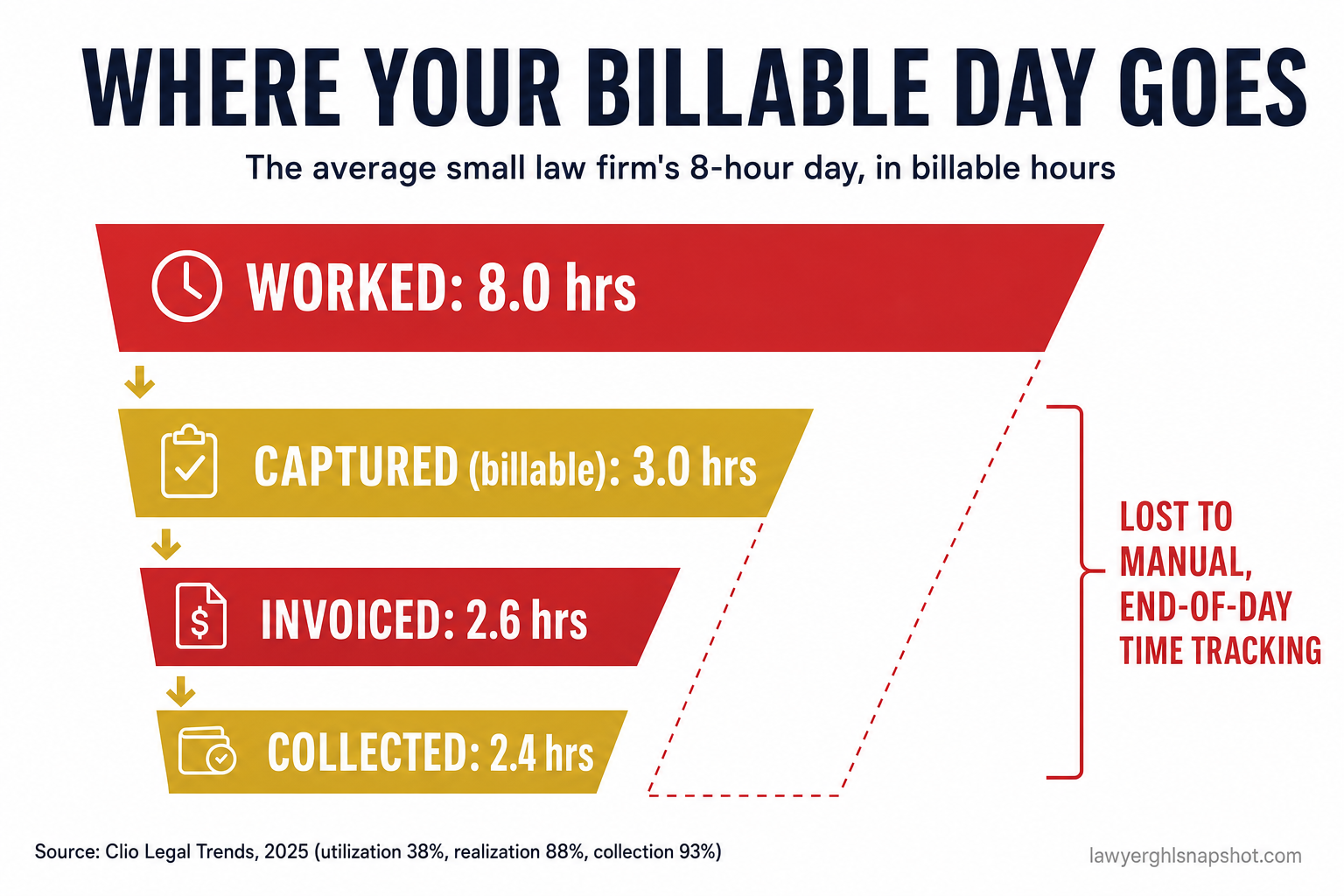
That gap has a price, and it is bigger than almost any software line item you argue about. The average firm captures about 3.0 billable hours out of an 8-hour day and collects only 2.4 of them (Clio Legal Trends, 2025). Manual, reconstruct-it-later time tracking is where most of that gap leaks. For a solo billing a normal rate, the hours you worked but never recorded add up to roughly $30,000 to $40,000 a year. For a 15-attorney shop, the same habit hides north of half a million.
This is the math nobody runs, laid out for three firm sizes, plus the six places the hours disappear and a capture routine you can copy today.
Key Takeaways
- Small firms bill a fraction of the day they work. Utilization sits at 38%, about 3.0 billable hours in an 8-hour day, and after realization and collection only 2.4 hours turn into cash (Clio, 2025).
- Manual, end-of-day entry is the biggest leak. Time reconstructed from memory is undercounted, because the short calls, texts, and emails that fill a day are exactly the ones you forget by 7pm.
- Small tasks are where the money hides. The U.S. standard is the six-minute (0.1 hour) increment (CosmoLex, 2026). Ten forgotten 0.1-hour touches a day is a full billable hour, gone.
- The dollar figure scales hard. Losing half a billable hour a day is roughly $33,000 a year for a solo, about $172,000 for a 5-attorney firm, and over $560,000 for a 15-attorney firm (illustrative math at typical rates).
- Reconstructed time is also a compliance risk. Billing from memory rather than contemporaneous records is harder to defend in a fee dispute and, if it inflates the bill, is an ethics problem under Model Rule 1.5.
Table of contents
- What manual time tracking actually costs you
- The six places your billable hours disappear
- The real dollar math: solo, 5-attorney, 15-attorney
- Steal this: a contemporaneous capture routine
- The compliance angle nobody mentions
- Does timekeeping software fix this on its own?
- Common objections
- FAQ
What does manual time tracking actually cost?
Start with the day you already work. In Clio’s Legal Trends data, the average lawyer’s utilization rate is 38%, about 3.0 billable hours in an 8-hour day. Of what gets captured, the realization rate is 88% (the share that makes it onto an invoice) and the collection rate is 93% (the share of invoiced time that gets paid). Run those in order and a full day of work turns into roughly 2.4 hours of collected, billable time (Clio, 2025).
An 8-hour workday, in billable hours, at average small-firm utilization (38%), realization (88%), and collection (93%). Source: Clio Legal Trends, 2025.
Now put a rate on it. The average solo attorney bills about $288 an hour, and the U.S. average is around $349 (Clio, Attorney at Work, 2025). Not all of the missing five hours were billable, that is the honest caveat. But a meaningful slice was billable work you did and never wrote down, and that slice is the part manual tracking directly controls. The gap between the 3.0 hours you capture and the 2.4 you collect alone is 0.6 of an hour a day of work you already did that never becomes cash: about $39,700 a year at a solo’s rate over 230 days, before you count the time you never captured at all.
Where do the billable hours actually disappear?
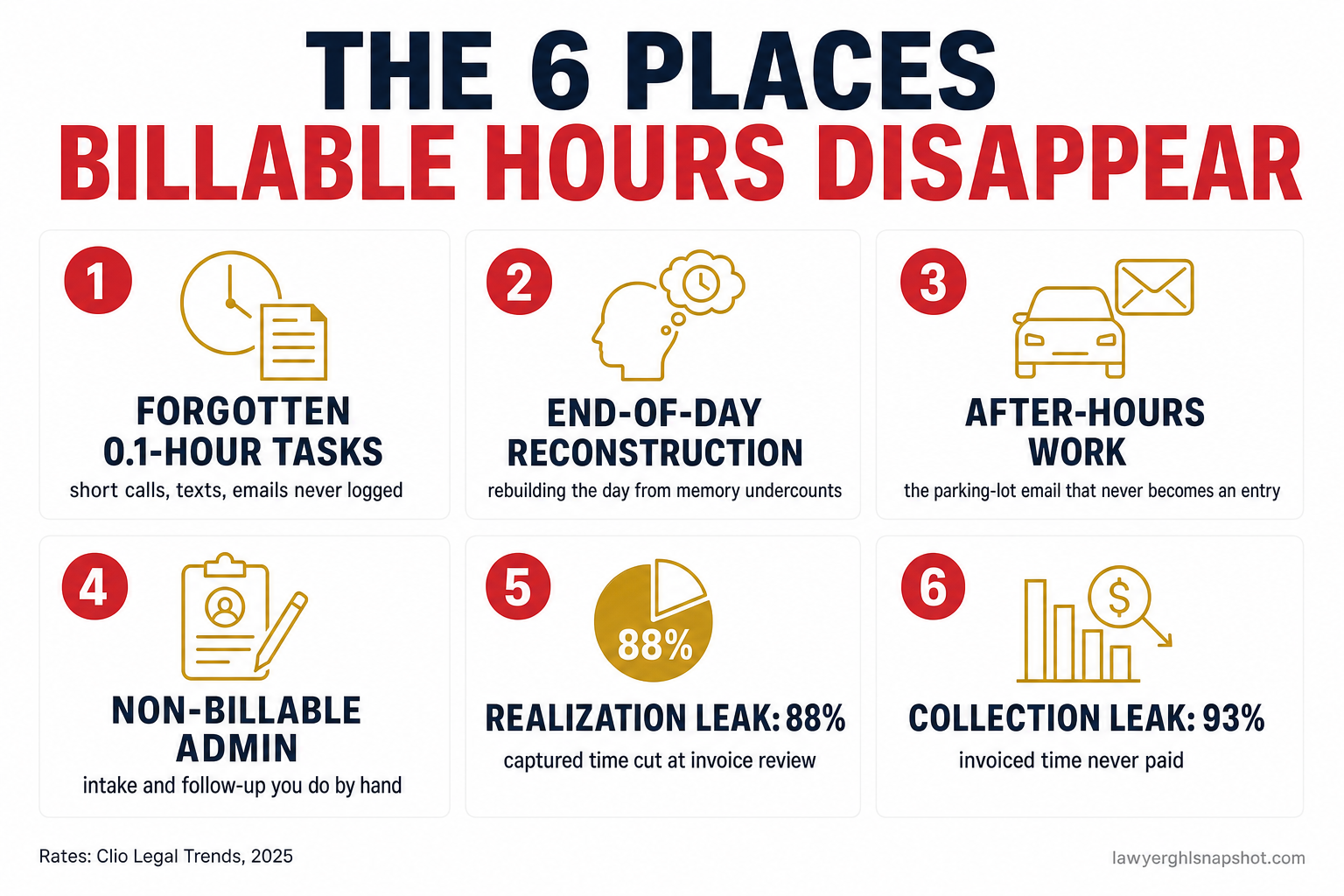
Six leaks, in the order they cost you the most.
1. The 0.1-hour tasks you never write down
The U.S. billing standard is the six-minute increment, or 0.1 of an hour (Bill4Time, 2026). A two-minute status call is a defensible 0.1. The problem is that these tasks are frequent, tiny, and instantly forgettable. A quick email, a text to a client, a docket check. None feel worth stopping to log, so you do not, and by Friday they have evaporated.
How it breaks: ten of these a day, unlogged, is a full billable hour lost every day, roughly $66,000 a year at $288 if you captured none. Nobody loses all ten. Almost everyone loses half.
What to do: log the task in the same ten seconds you finish it, not at day’s end. The entry does not have to be pretty. It has to exist.
2. End-of-day (or end-of-week) reconstruction
This is the single largest leak in small firms, and it is a memory problem, not a laziness one. When you rebuild the day at 7pm, you remember the big blocks (the drafting session, the deposition) and lose the connective tissue (the six calls, the ten emails). The big blocks were going to get billed anyway. The connective tissue is the revenue only contemporaneous capture saves.
How it breaks: reconstructed time is systematically rounded down, because you cannot bill what you cannot remember, and most lawyers, uneasy about padding, round conservatively when guessing.
What to do: shrink the gap between doing the work and logging it to near zero: a timer you start when the call connects, a one-line note from your phone, an intake system that timestamps first contact automatically.
3. The after-hours call, text, and email that never becomes an entry
The settlement email from the parking lot. The 8:40pm “quick question” text. The Sunday call. This work is real, often billable, and it happens when you are furthest from your billing software. So it never gets entered, and it quietly trains clients that your after-hours time is free.
How it breaks: the more responsive you are, the more of your work happens off the record. Your best client-service instincts become your biggest write-off.
What to do: capture at the point of contact. If a missed call, text, or web inquiry creates a timestamped record the instant it arrives, the work is documented before you are back at your desk. That is the same speed-to-lead plumbing that wins the client, pointed at your own billing.
4. Non-billable admin eating the day you think you billed
Part of why utilization sits at 38% is that much of the day is genuinely not billable: business development, internal meetings, doing the intake calls yourself. That is not a time-tracking failure. It is a delegation and automation failure, and it does not show up as a write-off. It shows up as a shorter day.
How it breaks: you feel busy for ten hours and bill for three, then conclude you need to work longer, when the real fix is to stop personally doing the unbillable intake and follow-up.
What to do: move the repeatable admin off your plate. Automated intake, reminders, and follow-up recover billable capacity without adding hours, the point of a documented intake process and, past a certain volume, a trained intake VA.
5. The realization leak: captured but never invoiced
You logged the time, and then it did not make it onto a bill. Realization sits at 88%, so 12% of captured billable time never gets invoiced (Clio, 2025). It gets cut at invoice review because the total makes a partner nervous, or because vague, block-billed entries are too weak to defend.
What to do: the vaguer your entries (a symptom of reconstruction), the more gets cut, because you cannot defend “0.5 misc.” but you can defend “0.5 review demand letter; call adjuster re: policy limits.” Specific, contemporaneous entries survive review.
6. The collection leak: invoiced but never paid
Collection sits at 93%, so even after invoicing, 7% of the money is never collected (Clio, 2025). Reconstructed billing makes this worse, because you invoice late, get paid late, and get paid less.
What to do: bill closer to the work, on a schedule, with reminders. And keep trust-funded fees clean, because a sloppy IOLTA reconciliation turns a collection problem into a discipline one.
The real dollar math: solo, 5-attorney, 15-attorney
The per-hour leak is small. That is why it is invisible. Multiply it by timekeepers and working days and it becomes the largest recoverable number in your firm. The math below is illustrative arithmetic, not a survey: it assumes each timekeeper loses just half a billable hour a day, across 230 working days, at typical rates. Given the six leaks above, half an hour is conservative. The bill scales fast: about $33,000 a year for a solo (near $40,000 at the full capture-to-collection gap), roughly $172,500 for a 5-attorney firm, and over $560,000 for a 15-attorney firm. The leak is not a rounding error, it is a partner’s draw.
Annual value of just 0.5 lost billable hours per timekeeper per day, across 230 working days, at typical rates ($288 / $300 / $325). Illustrative math, not a survey. Rate benchmarks: Clio, Attorney at Work, 2025.
What half a lost billable hour a day costs, by firm size
| Plan | Solo | 5-Attorney Firm recommended | 15-Attorney Firm |
|---|---|---|---|
| Price | ~$33,000/yr | ~$172,500/yr | ~$560,000/yr |
| Feature 1 | 1 timekeeper at $288/hour | 5 timekeepers at $300/hour | 15 timekeepers at $325/hour |
| Feature 2 | 115 lost hours a year; ~$40k at the full gap | 575 lost hours; a paralegal salary gone | 1,725 lost hours; why big firms mandate it |
Steal this: a contemporaneous time-capture routine
You do not fix this with willpower. You fix it by shrinking the distance between doing the work and recording it. Here is the routine, plus the automation rules that do the remembering for you. Copy it.
Now automate the parts you should never have to remember. These are the rules a well-built intake system runs for you, so the record exists before you touch it:
-
Every missed call creates a timestamped contact record and an instant text-back. The after-hours call you would have forgotten is now documented, and the caller gets an immediate reply. Here is the auto-text a firm can send the moment a call is missed:
“Hi, this is [Firm Name]. Sorry we missed you. Someone will reach out shortly. If it helps, reply here with a quick note about your situation and the best time to reach you. This is an automated message and not legal advice.”
-
Every web form and chat inquiry is logged with a timestamp and routed. The time you spend on the first response is captured against a real contact instead of vanishing into your inbox. Your website should be converting these to consultations, not dropping them.
-
Every client text runs through one tracked number, not a personal cell. After-hours texting becomes a logged, billable, TCPA-compliant thread.
-
Booked consultations and reminders fire automatically, so the intake work you used to do by hand is off your plate, the delegation fix for leak four.
The point is not to buy another timer. It is to make the record of your work appear automatically, so tracking stops depending on your memory at 7pm.
The compliance angle nobody mentions
Manual, reconstructed time tracking is not only a revenue problem. It is a professional-responsibility problem, and it cuts both ways.
Reconstructed time is harder to defend. Under ABA Model Rule 1.5, a lawyer’s fee must be reasonable, and in a fee dispute contemporaneous records are treated as the reliable ones. Time rebuilt from memory invites the question you cannot answer: “How do you know it was 0.5 and not 0.2?” Courts have reduced fee awards over vague, reconstructed records. The habit that undercounts your revenue also weakens your position the day a bill is challenged.
Reconstruction that rounds up is a discipline risk. If guessing nudges entries higher, that is billing for time you cannot prove you worked, the fast path to a bar complaint. Contemporaneous capture protects you from both underbilling and the temptation to overbill.
The fee-share trap with vendors. Vendors sell “solutions” for exactly this pain, and some propose a cut of what they help you recover. Be careful: Model Rule 5.4 bars sharing legal fees with a non-lawyer, and Rules 7.1 and 7.2 limit what you can pay for and how a service may present you. A flat fee is a defensible business cost; a percentage of your fees is a conversation with disciplinary counsel. This is not legal advice, so confirm your state’s rules, but the rule of thumb is simple: pay flat, never share the fee.
Does timekeeping software fix this on its own?
Not by itself, and this is where firms overspend. Every major case management platform has a timer, and it does not matter, because it still relies on you remembering to press it. Adoption of newer AI-assisted capture is still early in small firms: only 17.7% of solo practitioners and 24.1% of firms with 2 to 9 attorneys reported using AI tools, versus 47.8% at the largest firms (ABA 2024 AI TechReport). The smallest firms, the ones the leak hurts most, are the least likely to have automated any of it.
The honest split: your case management system (Clio, MyCase, whichever you already chose) should own matters, trust accounting, and the invoice. But the capture problem starts before any of that, at the missed call, the after-hours text, the web inquiry. Automating that front end, so every interaction is timestamped the instant it happens, is what recovers the hours. The timer in your billing software cannot capture a call it never knew you took.
Common objections
“I’ll remember to put my time in later.” You remember the big blocks and lose the small ones, and the small ones are the leak. This is how every busy person’s memory works. The fix is not trying harder. It is closing the gap between the work and the entry so there is nothing to remember.
“Stopping to log time interrupts the work.” Not if it is a ten-second, one-line entry or an automatic timestamp. The interruption to worry about is the bigger one at 7pm, when you stop everything to rebuild a day you can no longer see clearly, and still lose money doing it.
“I already pay for Clio’s timer, so I’m covered.” Only for the moments you remember to start it. The recoverable hours are in the contacts that happen away from your desk, which is why capture has to start at the point of contact, automatically, not at billing.
“I do flat-fee work, so tracking doesn’t matter.” It matters more, not less. On flat fees, tracked time is how you know whether the fee is profitable and where to set next year’s price. A firm that flat-bills without tracking is flying blind on its own margins.
Frequently asked questions
How much money do small law firms lose to manual time tracking?
The leak is large. Average small-firm utilization is 38%, about 3.0 billable hours captured in an 8-hour day, and only about 2.4 hours collected (Clio Legal Trends, 2025). As illustrative math, losing just half a billable hour a day is roughly $33,000 a year for a solo at $288/hour, about $172,500 for a 5-attorney firm, and over $560,000 for a 15-attorney firm.
Why is reconstructing time from memory a problem?
You remember the big work blocks and forget the short calls, texts, and emails that fill a day, and those small tasks are exactly where the money leaks. Reconstructed entries are also vaguer, so more gets cut at invoice review, and they are harder to defend in a fee dispute because courts treat contemporaneous records as the reliable ones under Model Rule 1.5.
What is the standard billing increment for lawyers?
The U.S. standard is the six-minute increment, or 0.1 of an hour (CosmoLex, Bill4Time, 2026). It captures a two-minute call as a defensible 0.1. Because these tasks are small and frequent, they are the ones most often forgotten, which is why ten unlogged 0.1 tasks a day adds up to a full billable hour lost.
Will case management software fix my time-tracking leak?
Only partly. Every platform has a timer, but a timer still depends on you remembering to start it. The recoverable hours are in contacts that happen away from your desk: missed calls, after-hours texts, and web inquiries. The fix is capturing those automatically, with a timestamp, the instant they happen.
Is it unethical to bill time reconstructed from memory?
It is risky. If reconstruction inflates the bill, you are billing for time you cannot prove, a discipline risk under Model Rule 1.5's reasonableness requirement. Contemporaneous records protect you both ways: they stop underbilling and remove the temptation to overbill. This is general information, not legal advice; confirm your state's rules.
How do I capture more billable time without working more hours?
Shrink the gap between the work and the entry. Log short tasks in the same ten seconds you finish them, run a timer for anything over five minutes, and automate the front end so missed calls, texts, and web forms create timestamped records on their own. Recovering half a lost hour a day is worth more than most rate increases.