It is 8:15 on a Tuesday and a new personal injury lead just filled out the form on your website. Your intake coordinator is in deposition prep, so your automation fires a text back in nine seconds and a chatbot offers three consultation slots. That is a firm winning the speed-to-lead race. But one question decides whether that text was smart marketing or a $500 problem: did that person agree to be texted, and is your number even registered to send business messages?
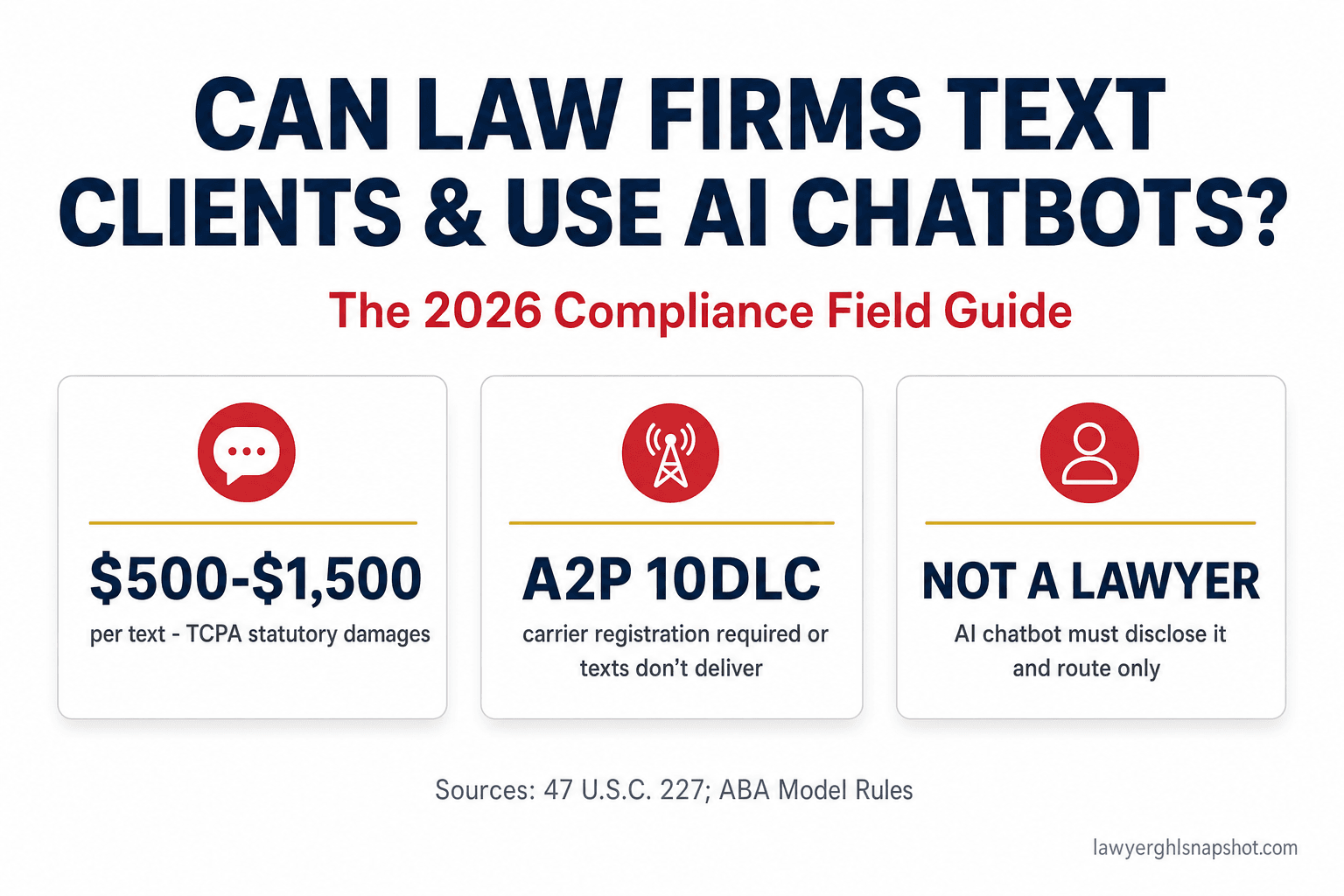
The short answer: yes on both. A law firm can text clients and prospects, and it can run an AI chatbot to answer questions and book consultations. Both are legal, and both are how small firms compete with the billboard shops. But both live inside overlapping rules: the TCPA, carrier registration (A2P 10DLC), your state bar’s advertising and solicitation rules, and the unauthorized-practice-of-law line your chatbot must never cross. Set it up right once and it runs for years. Set it up sloppily and one campaign becomes a class action or a bar grievance. Here is the field guide, in the order the rules actually bite.
Key Takeaways
- Texting leads and clients is legal, but marketing texts need prior express written consent under the TCPA. Statutory damages run $500 per text, up to $1,500 for willful violations (Cornell LII, 47 U.S.C. § 227).
- A2P 10DLC registration is not optional. Unregistered business texts get filtered or blocked by the carriers, so a “compliant” campaign that never registers simply fails to deliver (The Campaign Registry).
- An AI chatbot must disclose it is not a lawyer and stick to routing and scheduling. Answering “what are my chances” risks unauthorized practice of law and blows up privilege (ABA Model Rule 5.5).
- Bar advertising rules govern every automated message. Rules 7.1, 7.2, and 7.3 cover misleading claims, lead-gen payments, and solicitation; Rule 5.4 blocks the revenue-share deals vendors love to pitch (ABA Model Rules).
- State filing rules differ. Florida wants most paid ads filed 20 days before first use; Texas lets you file within 10 days after. Your own website is usually exempt in both, until you boost it.
Table of contents
- Can a law firm legally text clients and leads?
- What is A2P 10DLC, and why will your texts silently fail without it?
- Can a law firm use an AI chatbot without committing UPL?
- Which bar advertising rules apply to your automation?
- Florida vs. Texas: how ad-filing rules differ
- Steal this copy: compliant consent, opt-out, and disclosure language
- What compliance looks like at three firm sizes
- Where firms get this wrong
- Common objections
- Frequently asked questions
Can a law firm legally text clients and leads?
Yes, and it is one of the highest-return moves a small firm can make, because speed-to-lead is decided in minutes and text is where people actually reply. The catch is consent.
The Telephone Consumer Protection Act (TCPA) governs automated texts and calls. The rule that matters most: a marketing text sent with an autodialer needs prior express written consent before it goes out (FCC). The person affirmatively agreed, in writing, to receive marketing messages at that number, and the agreement was not buried as a condition of getting a free consultation.
There is an important split. A transactional or informational text, like a reply to someone who just messaged you or a booked-appointment reminder, sits in a lighter bucket than a marketing blast. The safe rule: if the message sells, promotes, or nurtures, treat it as marketing and get written consent first. If they contacted you and you are answering their question, you are on firmer ground, but still keep a record of how it started.
Why be this careful? TCPA statutory damages are $500 per message, and up to $1,500 for willful or knowing violations, with no cap (Cornell LII, 47 U.S.C. § 227(b)(3)). Plaintiffs’ firms run these as class actions, so the math gets ugly fast.
Those figures are not a prediction, just arithmetic on the statutory minimum, and they explain why the consent record is your most important asset. If you cannot prove, per contact, that someone said yes, you do not have a marketing list. You have a liability.
What is A2P 10DLC, and why will your texts silently fail without it?
Consent is only half of it. A second gate has nothing to do with law and everything to do with whether your texts arrive.
A2P 10DLC stands for Application-to-Person messaging over 10-digit long codes, the plain phone number your firm texts from. In 2021 the US carriers started requiring every business that sends automated texts to register its brand and campaign through The Campaign Registry (The Campaign Registry). Unregistered traffic gets throttled, filtered to spam, or blocked. There is no bounce message. The text just does not land.
This trips up firms constantly: they build a text-message follow-up sequence, send the first batch, and watch reply rates sit near zero, because the number was never registered. Legal, and invisible at the same time.
Registration is a one-time setup with ongoing hygiene. You register the legal entity (the brand), then the use case (the campaign), with real sample messages and a working opt-out. Approval hinges on three things: the sender is clearly identified, the purpose matches your sample copy, and every path includes a working opt-out. That is the copy the TCPA and your bar want anyway.
Can a law firm use an AI chatbot without committing UPL?
An AI chatbot answers instantly at 2 a.m. and books the consultation while interest is high, which makes it one of the best tools a small firm can add. But a chatbot that talks like a lawyer is a real problem.
Two lines cannot be crossed. First, the bot must not practice law. Giving specific legal advice, predicting outcomes, or telling someone what their claim is worth is lawyering, and software is not admitted to your bar (ABA Model Rule 5.5). When a visitor types “what are my chances,” the wrong answer is an estimate. The right one is a warm hand-off: acknowledge the question, explain that only an attorney can evaluate it, offer a consultation.
Second, the bot must disclose what it is. A visitor should never believe they are chatting with an attorney or that anything they type is protected. Say it plainly, up front: this is an automated assistant, not a lawyer, and messages are not confidential until you have a signed engagement. That protects the visitor and protects you, because it heads off the argument that a prospect thought they had formed a relationship in confidence.
Configured this way, an AI receptionist becomes a router, not an advisor. It qualifies, schedules, and hands off cleanly. Useful, and on the right side of the line.
Which bar advertising rules apply to your automation?
Federal texting law and carrier rules are only half the picture. Every automated message your firm sends is still an attorney communication, so your state’s version of the ABA Model Rules applies. Four rules do most of the work:
Rule 7.1, no false or misleading communications. Everything your automation says has to be true and not misleading, across texts, chatbot scripts, and nurture emails (ABA Model Rule 7.1). No implied guarantees, no “we win every case,” no invented urgency.
Rule 7.2, communications and lead generation. You can pay for advertising and pay a lead-generation service, but only if the generator does not recommend or vouch for you or create the impression it is steering the client to a specific lawyer (ABA Model Rule 7.2). A vendor that says “we matched you with the best DUI attorney in town” is the kind of arrangement that gets a firm in trouble.
Rule 7.3, solicitation. This restricts live, real-time solicitation of people who did not ask to hear from you when a big motive is money (ABA Model Rule 7.3). Replying to someone who filled out your form is fine. Cold-blasting accident victims scraped from a police report is not.
Rule 5.4, no fee-sharing with non-lawyers. This one quietly kills a lot of vendor pitches. A marketing company that wants a percentage of the fees from cases it sends is proposing something the rules broadly prohibit (ABA Model Rule 5.4). Flat fees for services, yes. A cut of the recovery, no.
Florida vs. Texas: how ad-filing rules differ
Some states also make you file your ads with the bar for review, and the timing changes your launch calendar. Two big markets show the range.
| Rule | Florida | Texas |
|---|---|---|
| When you file paid ads | Up to 20 days before first use for advance review | Within 10 days after first dissemination |
| Advance clearance | Yes, part of the standard process | Optional, voluntary pre-clearance available |
| Your own website | Generally exempt, unless you boost or run it as a paid ad | Generally exempt from the filing requirement |
| Practical effect | Build a pre-launch buffer into your calendar | Launch first, file promptly after |
The operator takeaway: Florida needs lead time, so you cannot decide Friday to launch a promoted post Monday. Texas lets you move faster, but “file within 10 days after” is a deadline, not a suggestion. In both, your ordinary website sits outside the filing rule until you put paid spend behind it. Confirm the current rule and any fee with your state bar.
Steal this copy: compliant consent, opt-out, and disclosure language
Rules are abstract. Copy is not. Here is language you can adapt today, written to satisfy consent, carrier registration, and bar disclosure at once. Have your own counsel review it for your state before it goes live.
Two phrases do the heavy lifting: “consent is not a condition of hiring the firm” (so consent is not coerced) and “Reply STOP to opt out at any time” (the required exit). Leave the box unchecked so the person affirmatively opts in.
Identify the firm, remind the recipient why they are hearing from you, and give STOP and HELP.
That last line matters: many states require an “attorney advertising” label and a prior-results disclaimer on paid promotion.
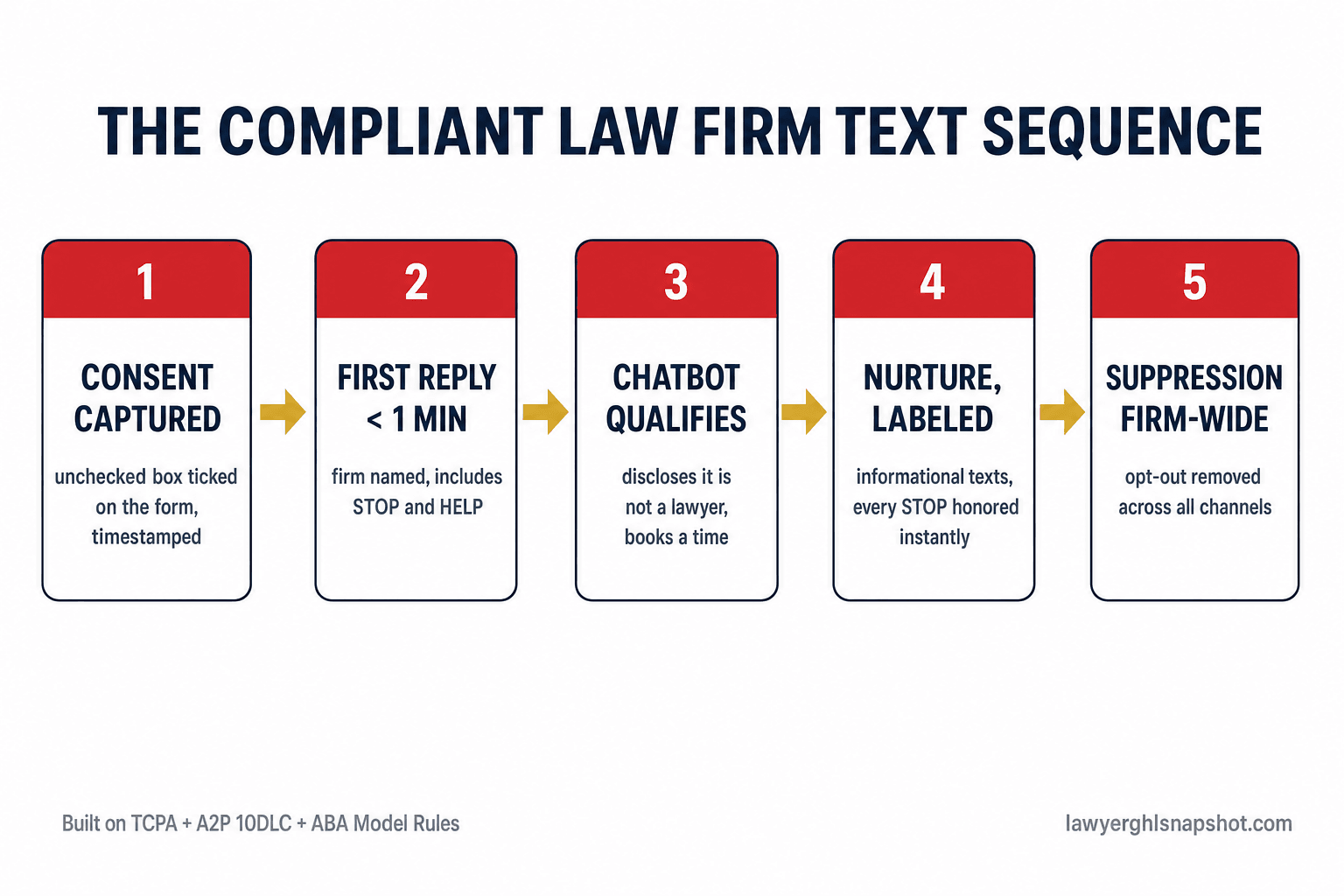
Those pieces snap into a simple sequence. Consent comes first (the form submission with the unchecked box ticked, timestamped as your record). The first automated reply, under a minute later, identifies the firm and carries STOP and HELP. The chatbot then qualifies and offers times without giving advice. Nurture texts stay informational, and every STOP suppresses the contact across all channels instantly. Nothing sells before the person agreed to hear from you.
What compliance looks like at three firm sizes
The rules are the same for everyone. The setup that satisfies them scales with the firm.
Solo or two-attorney firm. You are the compliance officer whether you want to be or not. Keep it simple and airtight: one consent checkbox, one properly registered texting number, a chatbot with the disclosure baked into its first message, and a habit of honoring STOP the second it comes in. Your biggest risk is not a class action, it is buying a lead list or letting a cheap vendor text without consent. Your intake process and your consent record are the same system.
Mid-size firm, three to eight attorneys. With staff sending messages from multiple sources, the risk is inconsistency: one paralegal texts from a personal cell, another uses the registered number, and consent records live in three places. Centralize it. Every message flows through one registered, logged system, consent is captured identically, and opt-outs suppress firm-wide. A database reactivation campaign is especially risky here: texting old contacts you never got consent from is a classic TCPA trap.
Larger firm, nine to fifteen-plus attorneys. At real volume you need an audit trail you could hand to opposing counsel without flinching: per-contact consent timestamps, versioned bar-reviewed templates, documented A2P registrations, and a monitored suppression list. The question stops being “are we compliant today” and becomes “can we prove we were compliant on the date of any given message.” No record, no defense.
Where firms get this wrong
Most compliance failures are the same handful of mistakes, over and over.
Buying or scraping lists. A purchased list has no consent, full stop. Texting it is the fastest route to TCPA liability there is, and “but they were in a car accident” is not consent.
Treating a booked call as a marketing opt-in. Someone who scheduled a consultation agreed to that, not to a twelve-message nurture sequence. Get marketing consent explicitly and separately.
Ignoring A2P registration. The texts are legal and never delivered. Firms burn weeks blaming their copy when the real problem is an unregistered number in carrier purgatory.
A chatbot that answers legal questions. The moment the bot estimates a case value or says “you have a strong claim,” you have a UPL and privilege problem. Script it to route, never to advise.
Honoring STOP slowly, or in only one place. An opt-out has to be immediate and firm-wide. If someone replies STOP to a text and then gets an email blast next week, the opt-out failed, and so did you.
Revenue-share vendor deals. A percentage-of-fees arrangement violates Rule 5.4 in most states. However good the leads are, if the pricing is a cut of recoveries, walk.
Common objections
“Won’t all this consent friction cost me leads?” A single unchecked box costs almost nothing in conversion and protects you from five- and six-figure exposure. Compliance is not a tax on speed-to-lead. It is what keeps the channel working.
“I already use Clio or MyCase. Doesn’t that make me compliant?” No. Practice-management software stores your matters. It does not register your texting number for A2P, capture marketing consent on your web forms, script your chatbot’s disclosures, or maintain a firm-wide suppression list. Those jobs sit alongside your case system. If you are weighing a move to a unified system, map who owns consent and opt-out before you migrate.
“Do I need to be technical to set this up?” No, but someone has to own it. The registrations, consent copy, and chatbot scripts are a one-time build. The ongoing work is discipline: honor every STOP, never buy a list, keep the records.
“My state hasn’t come after anyone for texting. Why bother?” TCPA enforcement is largely private, not state-driven. You do not need your bar to notice. You need one recipient with a plaintiff’s lawyer and a screenshot.
Frequently asked questions
Can a law firm text a potential client who filled out a contact form?
Yes. Someone who submits your form and asks to be contacted has invited a response. Reply promptly, identify your firm, and include an opt-out. For ongoing marketing texts beyond that first reply, capture prior express written consent, usually with an unchecked checkbox on the form.
What is the penalty for a TCPA violation?
Statutory damages are $500 per message, up to $1,500 for willful or knowing violations, with no overall cap. Because these are commonly litigated as class actions, exposure scales with the size of the send, which is why per-contact consent records matter so much (47 U.S.C. § 227(b)(3)).
Do I really need A2P 10DLC registration to text from my business number?
Yes. Since 2021, US carriers require businesses to register their brand and campaign through The Campaign Registry to send application-to-person texts. Unregistered messages are filtered, throttled, or blocked, with no failure notice. Your texts simply do not arrive.
Is it legal for a law firm to use an AI chatbot on its website?
Yes, as long as the chatbot discloses it is an automated tool and not an attorney, does not give legal advice or predict outcomes, and makes clear that conversations are not confidential until an engagement is signed. Scripted to route and schedule rather than advise, it stays clear of unauthorized-practice-of-law and privilege problems.
Can I pay a marketing agency a percentage of the fees from leads they send me?
In most states, no. ABA Model Rule 5.4 broadly prohibits sharing legal fees with non-lawyers. You can pay flat fees for advertising and services, but a cut of recoveries is a fee-sharing arrangement the rules prohibit. Treat a revenue-share pitch as a red flag.
Texting, chatbots, and automated follow-up are not risky because the law forbids them. They are risky because most firms bolt them on without the consent record, the registration, and the disclosures that make them safe. Do those three things and you get the upside, an intake system that answers in seconds and books while you sleep, without the exposure. The firm that set it up right does not just reply fast. It replies fast, with consent on file, from a registered number, through a bot that knows what it is.