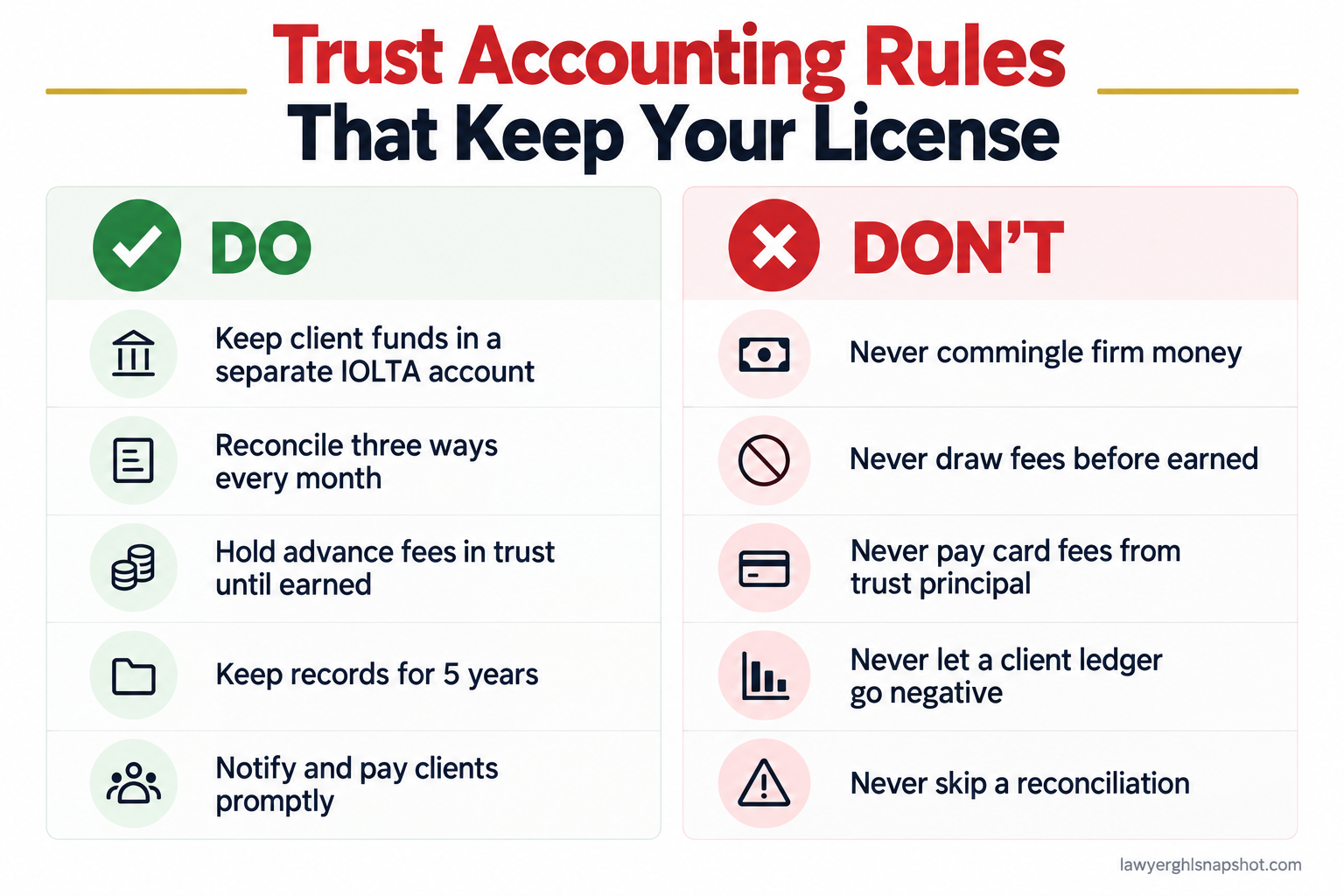
It is the third Tuesday of the month, and your bank statement does not match your books. A settlement check cleared, a filing fee went out, and somewhere in there the trust balance is off by $214. You did not take anything. But a $214 gap you cannot explain is the kind of thing that becomes a grievance, and a grievance about client money is the one kind your bar takes personally.
Here is what nobody drills into you in law school. Most trust-account discipline is not theft. It is sloppiness. A fee drawn a week too early. Processing fees skimmed off the wrong account. A reconciliation skipped for three months because you were in trial. Safekeeping client property is close to a strict-liability corner of legal ethics, and the firms that get burned are rarely the crooks. They are the busy ones.
So here is the short version. Trust accounting is not a bookkeeping chore you can hand off and forget. It is a system: the right account structure, a monthly three-way reconciliation, clean records kept for years, and client communications that go out on time. Get it right and the audit is boring. Get it wrong and a $214 gap can cost you your license. This guide walks the rules, the seven ways small firms blow it, and the reminder layer that keeps you clean when you are too busy to think about it.
Key Takeaways
- Trust accounting is a systems problem, not an accounting one. Most discipline comes from missed reconciliations, early fee draws, and commingling, not theft (ABA Model Rule 1.15).
- Client money lives in a separate account, always. Rule 1.15 bars commingling and only lets you keep enough firm money in trust to cover bank fees.
- Advance fees are the client’s until you earn them. Retainers paid up front go into trust and come out only as the work is done (ABA Formal Opinion 505, 2023).
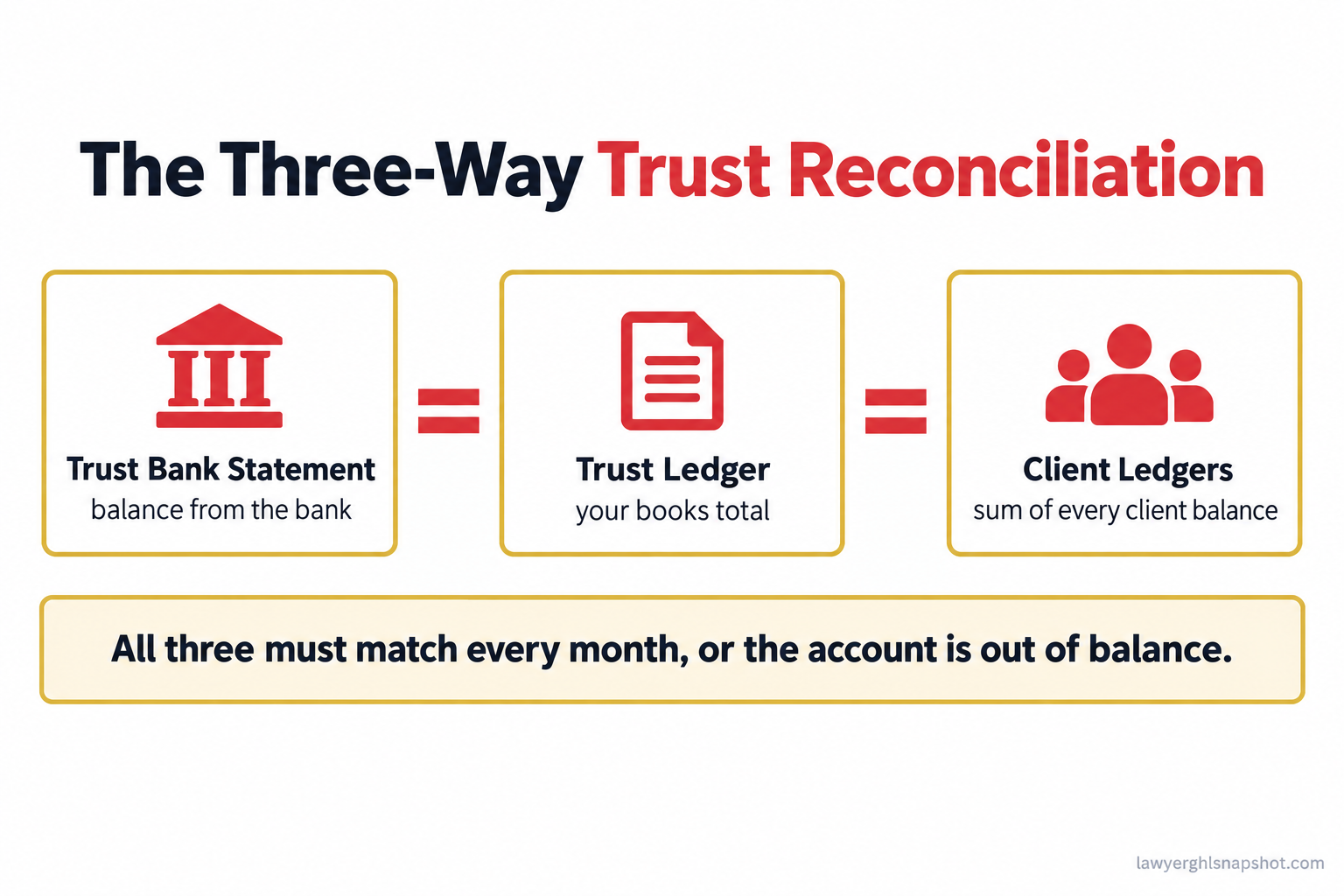
- Three-way reconciliation is the whole game: bank balance, book balance, and the sum of every client ledger must agree, every month.
- The failure is almost always a missed step, so automate the steps. Deposit receipts, replenishment requests, refund notices, and a monthly reconciliation reminder are the difference between a clean audit and a career problem.
Table of contents
- What is IOLTA, and what does trust accounting require?
- Why a bookkeeping slip becomes a bar complaint
- The 7 ways small firms blow trust accounting
- What goes in trust, and what stays out
- Steal this: the trust-account message cascade
- Run the same system at three firm sizes
- The line marketing vendors cross
- Common objections
- FAQ
What is IOLTA, and what does trust accounting actually require?
IOLTA stands for Interest on Lawyers’ Trust Accounts. When you hold client money too small or too short-term to earn net interest for that one client, you pool it in a shared, interest-bearing account, and the interest funds civil legal aid (ABA Commission on IOLTA). That is the interest side. The part that gets lawyers disciplined is the accounting side, governed by ABA Model Rule 1.15 and your state’s version of it.
Rule 1.15 asks for four things, simpler than the fog around them suggests. Keep client and third-party funds separate from your own money, in a dedicated trust account. Keep complete records of what came in, what went out, and whose money it is, for years after the matter ends (the Model Rule sets five years). Put advance and unearned money into trust and take it out only as you earn it. And when a client is entitled to their funds, notify them and pay promptly, with an accounting on request.
The only money of yours that belongs in there is a small cushion for bank charges. Everything else is somebody else’s, and your job is to prove, on any given day, exactly whose it is and how much. That is a discipline, and disciplines are the first thing to slip when you run a small shop.
Why does a small bookkeeping slip become a bar complaint?
Because your bar treats client funds differently from every other kind of mistake. Mishandle trust money and you face disciplinary counsel, where the standard is close to unforgiving: knowing misuse points toward disbarment even when the money is paid back, and commingling can draw discipline even when it was an accident and nobody lost a cent, because the rule protects the separation itself, not just the outcome.
States are also getting more active about checking. California now runs a Client Trust Account Protection Program that makes attorneys register every trust account, certify compliance yearly, and complete a self-assessment, and it began selecting firms for compliance reviews in 2025 (State Bar of California). New York’s bar has pushed for similar random audits (New York City Bar). A system that only works because nobody looks is a bet, and the odds are shifting against you.
None of this is legal advice, and trust rules vary by state. Confirm your own jurisdiction’s version of Rule 1.15 before you rely on anything here.
The seven ways small firms blow trust accounting
Almost every trust problem I have seen at a small firm is one of these seven, and none of them require bad intent. They require a busy person and no system.
1. Commingling firm money and client money
The original sin, and it happens quietly: an office expense paid from trust because that was the card in your hand, or earned fees left in trust because moving them is a hassle. The fix is structural. Two accounts, and no dollar crosses between them without a paper trail.
2. Drawing fees before they are earned
Advance fees belong to the client until you do the work. Take a $5,000 retainer, bill $1,200 this month, and you may move $1,200 to operating, not a dollar more. Draw the whole $5,000 because cash is tight and you have turned client money into a loan to yourself, misappropriation even if you mean to earn it. Bill first, then move only what the invoice says (ABA Formal Opinion 505).
3. Skipping the three-way reconciliation
The one that hides everything else. A three-way reconciliation means three numbers agree: your trust bank statement, your trust ledger, and the total of every client’s individual ledger. Most states expect it monthly, and three months skipped during trial is how a $214 gap becomes a mystery no one can unwind. Calendar it like a filing deadline.
4. Letting card processing fees eat trust principal
You take a card payment into trust, and the processor takes its cut before the money lands, so the account is now short, covered by other clients’ money. A violation created entirely by plumbing. Use a legal-specific payment setup that deposits the full client payment into trust and pulls fees from operating (Federal Bar Association).
5. Negative client ledgers, or borrowing from Peter
Every client’s ledger inside the trust account must stay at or above zero on its own. Disburse more for one client than they have on deposit and you are spending another client’s money, even though the overall account still looks positive. A positive account balance is not proof you are clean. Every individual ledger being positive is.
6. Not returning unearned money, or returning it silently
When a matter ends, unearned advance fees go back to the client promptly, and you tell them you are doing it (ABA Model Rule 1.15). “Prompt” is not “whenever I get to it,” and a refund that goes out late, or without a note showing the math, invites a complaint.
7. Records you cannot produce on demand
The rule is not satisfied by a clean bank account. It is satisfied by records: deposit slips, ledgers, canceled checks, and reconciliations, kept for years. If an auditor asks for a client ledger from three years ago and you cannot produce it, you have failed the rule even if not a dollar moved.
What goes in trust, and what stays out
Half of compliance is knowing which account a given dollar belongs in.
| Money | Where it goes | Why |
|---|---|---|
| Advance fees / unearned retainer | Trust | It is the client’s until you earn it |
| Settlement funds held for a client | Trust | You hold it, you do not own it |
| Filing fees and costs paid in advance | Trust | Client money for a specific purpose |
| Earned fees, after you bill them | Operating | Now it is yours, so move it out |
| A true earned-on-receipt retainer | Operating | Earned when paid, if your state allows it |
| Credit-card processing fees | Operating | Never deduct from trust principal |
| A small cushion for bank charges | Trust | The one bit of firm money allowed in |
| Rent, payroll, marketing, your salary | Operating | Never, under any story, from trust |
The rows that trip firms up are the retainer distinction and the processing fees. When you cannot tell whether a fee is an earned-on-receipt retainer or an advance against future work, hold it in trust. The safe error costs nothing. The unsafe one costs you a hearing.
Steal this: the trust-account message cascade
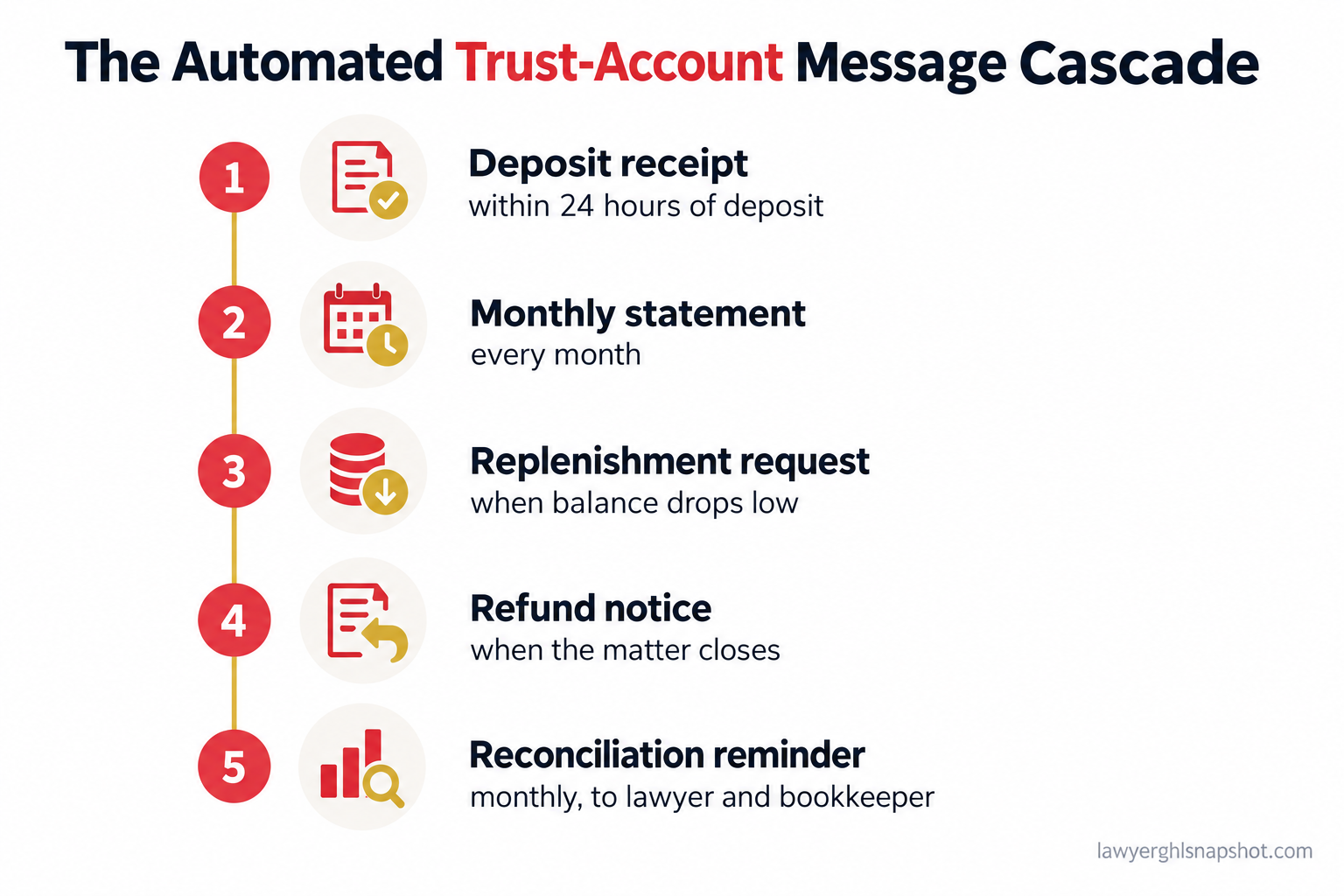
The seven failures all share a root cause: a step that did not happen on time. So the fix with the biggest payoff is not more accounting software, it is a set of messages that fire on schedule without you remembering them. Here is the copy. Adapt it to your voice and your state’s rules, and make every one of these automatic.
The cascade turns “I should reconcile this month” into a task that shows up on its own, and “I’ll refund that eventually” into a message that goes out the week the file closes. It is the same reminder machinery a firm uses for appointment and intake follow-up and structured client intake, pointed at the trust account instead of the calendar.
Run the same system at three firm sizes
The rules are identical for a solo and a fifteen-attorney firm. What changes is who does the steps and where the risk hides.
The solo. You are the lawyer, biller, and bookkeeper, so the reconciliation is the first thing to fall off when a trial hits. Your risk is not fraud, it is time. Make the monthly reconciliation a hard calendar event with a reminder you cannot dismiss, and automate the four client messages so they go out whether or not you are at your desk.
The five-attorney firm. Now the danger is fee draws. If any of five billers moves money out of trust before an invoice supports it, the account is off and nobody notices until reconciliation. Enforce one rule for everyone: no funds leave trust without a matching invoice, and one person owns the monthly reconciliation. Diffused responsibility is how a gap ends up with no owner.
The fifteen-attorney firm. The rules do not get harder, but the volume does, and the person reconciling is usually not the one who made each entry. Your risk is a bad entry buried in hundreds of good ones, so catch errors at the point of entry, not at month-end. Small firms lag badly on this automation: in the ABA’s 2024 survey, only 17.7% of solo practitioners reported using AI tools, against 47.8% at the largest firms. The gap is not the rule. It is the machinery around it.
The same leak that drains trust discipline drains firm revenue. In Clio’s Legal Trends data, average utilization runs about 38%, and after realization and collection a full 8-hour day becomes about 2.4 hours of collected time. Both leaks close with a system, not willpower.
How a lawyer’s day leaks from 8 hours to about 2.4 collected billable hours, using average utilization, realization and collection rates from Clio’s Legal Trends benchmarks. Skipped steps drain trust compliance the same way.
The line marketing vendors cross
The same rules that protect client money decide what you can buy from the vendors who pitch you. ABA Model Rule 5.4 bars sharing legal fees with a non-lawyer, so a vendor’s “we take a percentage of every signed case” is not a pricing question, it is a discipline question, and the answer is no. A flat monthly cost you can defend on an audit; a cut of your fees is a call with disciplinary counsel. If you run intake by text or an AI chatbot, the disclosure and consent rules stack on top.
Common objections
“Isn’t this my bookkeeper’s job?” They can do the mechanics, but the rule holds you responsible, not them. You can delegate the data entry, not the duty, which is why the reconciliation reminder goes to both of you: the bookkeeper does the work, you confirm it happened.
“My software already does trust accounting.” It keeps the ledger and makes the three-way reconciliation easier. It does not make you do it. Every tool that manages matters and billing, from Clio to the cheaper alternatives, still needs a human running the reconciliation and sending the messages. The tool is the ledger. The habit around it is what fails.
“I’ve practiced for years and never been audited.” That was the safe bet when audits were complaint-driven. It is a worse bet every year, as states like California move to registration, self-certification, and random compliance reviews (State Bar of California). “Never caught” is not “clean,” and one grievance is all it takes to put your account under a microscope. Small does not mean safe; it means the system matters more, not less.
Frequently asked questions
What is the difference between an IOLTA account and a regular trust account?
An IOLTA account is a pooled, interest-bearing trust account for client funds too small or short-term to earn net interest for one client; that interest funds legal aid (ABA). Larger or longer-held funds go in a separate, client-specific account that earns interest for that client. Both are governed by Rule 1.15.
How often do I have to reconcile my trust account?
Most states expect a three-way reconciliation at least monthly; some require it quarterly. It confirms that your trust bank statement, your trust ledger, and the sum of every individual client ledger all agree. Because the cadence is set by your state, confirm your own rule and treat that deadline like a court deadline.
Can I keep my own money in the trust account?
Only a small amount to cover bank service charges (ABA Model Rule 1.15). Leaving earned fees in trust, or parking firm money there for convenience, is commingling, a violation even if no client is harmed. Move earned fees to operating promptly after you bill them.
When can I move a retainer from trust to my operating account?
Only as you earn it. An advance or unearned retainer stays in trust until you do the work and bill it; then you move only the billed, earned amount (ABA Formal Opinion 505). A true earned-on-receipt retainer, where your state allows it, can go to operating when paid. Not sure which you have? Hold it in trust.
Can I deduct credit-card processing fees from my trust account?
No. The full client payment must land in trust, and processing fees come from your operating account. Skimming the fee off a trust deposit leaves the account short, covered by other clients' money, which is a violation (Federal Bar Association). Use a legal-specific payment setup that routes fees to operating.
My trust account is off by a small amount. Is that a problem?
Fix it now and document what you did. A small unexplained gap is not automatically discipline, but ignoring it is. Trace the entry that caused the difference, correct it with a paper trail, and if it came from firm error, restore it from operating funds. The danger is never the $200 gap. It is the skipped reconciliations that let it hide.
Trust accounting rewards the boring firm. Not the one with the fanciest software, but the one that reconciles on the same day every month, sends the same messages every time, and can produce any client’s ledger on demand. Start with the monthly reconciliation reminder and the five client messages above; everything else just keeps those from getting skipped. And none of this is legal advice; check your state’s version of every rule before you act.